



A first-time HMLV buyer receives a quote and finds the unit price running two to three times higher than the estimate built from a bill of materials alone. This is one of the most common reactions procurement teams have upon receiving their first quote for a High-Mix Low-Volume (HMLV) PCBA build, and the discrepancy is rarely the result of padding or excess margin. It reflects the underlying economics of HMLV manufacturing, where low order volumes mean fixed engineering costs are distributed across a far smaller number of units than in high-volume production.
Understanding that structure is what separates a well-negotiated quote from one that either overpays for unnecessary services or underpays in ways that surface later as change orders and schedule delays. What follows is a breakdown of the five cost components that constitute a typical HMLV PCBA quote, along with the benchmarks and warning signs that indicate whether a supplier's pricing reflects genuine engineering effort or a standardized template.
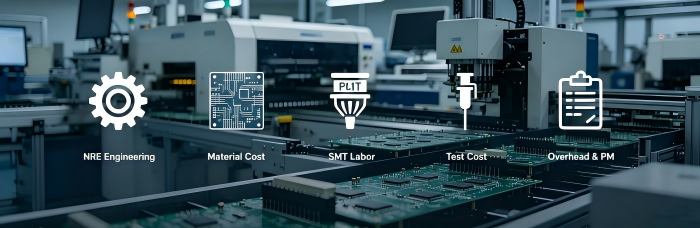
The Five Cost Components
A complete HMLV PCBA quote is composed of five layers, each with a distinct sensitivity to volume:
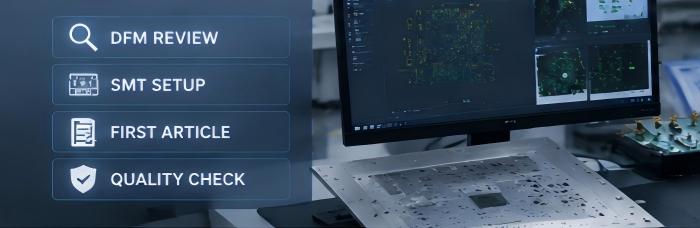
NRE / engineering setup — DFM/DFA review, stencil design, test programming, first-article verification
Material cost — components, PCB substrate, consumables
SMT labor and machine time — placement, reflow, inspection
Test costs — ICT, functional test, burn-in where applicable
Overhead and program management — quality documentation, traceability, project coordination
In a typical HMLV first-batch build, NRE and engineering setup account for roughly 25–40% of total cost — a proportion that would be nearly imperceptible in a 50,000-unit consumer electronics run. This is the primary reason HMLV unit prices appear disproportionate to buyers accustomed to high-volume pricing logic: the cost is not driven by additional materials, but by the engineering discipline required to properly qualify a process for a run too small to absorb setup costs invisibly.
What a Reasonable NRE Quote Looks Like
NRE is also where quote quality diverges most sharply between suppliers, as it is the line item most susceptible to being either omitted or inflated.
Three components typically constitute the NRE line. The first is the DFM/DFA review — a manufacturability assessment against IPC standards conducted before the build begins. The warning sign here is a review that is absent altogether, or reduced to a formality with no accompanying findings report. The second is stencil design and programming — the SMT stencil, pick-and-place programming, and test fixture setup specific to the board design. A flat fee applied regardless of board complexity suggests the work was not genuinely scoped to the design in question. The third is first-article inspection — dimensional and process verification performed on the initial production units. This component is frequently absorbed into the unit price without a distinct line item, which makes it difficult to confirm it was actually performed.
An NRE line that is entirely absent from a quote is not necessarily a cost advantage; more often, it indicates that engineering preparation was not performed, a gap that typically resurfaces as yield issues or rework further into the program. An unusually high NRE fee, conversely, may reflect a supplier applying overhead structures designed for large-account programs to a build that does not require them. The more useful benchmark is not a target figure, but a request for the supplier to itemize precisely what the NRE fee covers for the board in question.
How Unit Price Moves With Volume
HMLV cost curves behave differently from high-volume curves, and distinguishing which cost components genuinely decrease with volume — and which remain fixed — is essential to setting realistic expectations when negotiating batch size.
Consider the same board produced at three batch sizes: 30, 100, and 300 units. NRE per unit declines substantially across this range, moving from high to moderate to low, because a fixed engineering cost is amortized over a larger number of boards. Labor cost per unit follows a comparable, though more gradual, decline, as line efficiency improves with run size. Material cost and test cost per unit, however, remain essentially constant across all three batch sizes, since both scale with the board itself rather than with the size of the run.
This distinction matters in negotiation. Doubling batch size meaningfully reduces NRE amortization and per-unit labor cost, but has negligible effect on material and test cost, which are volume-independent. Buyers sometimes expect that doubling volume should roughly halve total unit cost; in practice, the reduction applies only to the volume-sensitive components. A quote showing a dramatic price drop across doubled batch sizes warrants closer scrutiny of which cost lines are actually driving that reduction.
Hidden Fees to Pin Down Before You Sign
The cost components above are generally visible on the quote itself. The fees that produce budget surprises later tend to surface only in contract terms — or not until an invoice arrives. Four categories warrant particular attention: a material overage or attrition allowance, a buffer for component loss during placement and rework, typically a modest percentage of BOM value, and worth confirming both the percentage and whether it is capped; Engineering Change Order (ECO) fees, triggered when a design revision is introduced mid-program, where it is worth clarifying the fee structure and how many revisions, if any, are included at no additional cost; expedite fees, premiums applied for compressed lead times, where a defined fee schedule across compression tiers should be requested rather than a general assurance that expediting is available; and re-inspection or re-test fees, charged when a batch fails initial testing and requires rework and re-verification, where it is worth establishing whether these are billed per occurrence or included up to a defined threshold.
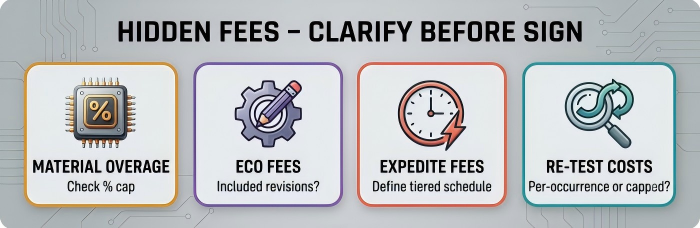
None of these fees are inherently unreasonable — each reflects a legitimate cost driver. The risk arises when their triggers and caps are not defined at the contract stage, leaving them open to interpretation once a program is underway. A thorough supplier evaluation should confirm, in writing, how each of these four categories is addressed before the first purchase order is issued.
Cost Transparency as a Supplier Quality Signal
One pattern is worth particular attention during supplier evaluation, and it has less to do with price than with a supplier's willingness to explain it. EMS providers able to walk through a quote line by line — NRE, material, labor, test, overhead — typically also maintain the mature costing systems, defined process controls, and quality infrastructure, often anchored by IATF 16949 certification, necessary to track cost at that level of granularity in the first place. Suppliers offering only a single bundled figure are frequently unable to disaggregate it, not merely reluctant to, because their internal systems were never built for HMLV cost tracking.
Quote transparency, in this sense, functions as a leading indicator of program transparency later on — in yield reporting, in traceability, and in how change orders are handled once production is underway.
At PCBCart, every HMLV quote is broken down by NRE, material, labor, and test cost before a program is confirmed, allowing buyers to evaluate the figure rather than simply accept it. For a line-item view of what a build like yours should cost, we offer a free DFM review alongside every formal quote, and our EMS Supplier Evaluation Scorecard is available for download to compare quotes across suppliers using a consistent cost framework.
Helpful Resources
• A Comprehensive Introduction of PCBA
• Printed Circuit Boards Assembly Process
• How to Enhance PCB Supply Chain Transparency?
• How to Create A Qualified BOM for Quick PCB Assembly Quotation and Production
• Electronics Manufacturing Services


