



High-mix, low-volume (HMLV) buyers in industrial automation, life sciences, and semiconductor test equipment encounter a recurring pattern: a Tier-1 EMS provider wins the quote, then underdelivers in execution. This is not a vendor-management failure. It is a structural mismatch between how large-scale EMS operations are engineered and what HMLV production actually demands.
The Tier-1 Business Model vs. HMLV Production Reality
Tier-1 EMS providers are optimized around a single variable: amortizing fixed costs across long, stable production runs. Their line layouts, staffing models, and financial targets all presuppose high-volume repeatability — the same board, the same program, the same fixture set, running for weeks or months at a stretch.
HMLV production inverts that assumption. A semiconductor test board program might total 40 units. The next lot may be a different ATE socket board requiring a different stencil, reflow profile, and fixture geometry. Each changeover consumes engineering time, line downtime, and setup labor that a high-volume line is not architected to absorb efficiently.
The conflict is economic in nature, not a matter of effort or intent:
Fixed-cost absorption favors long runs. An HMLV order cannot generate sufficient throughput to offset the changeover overhead the Tier-1 cost model requires it to carry.
Line balancing in large-scale operations is optimized for minimal SKU changeover, not frequent reconfiguration.
Engineering allocation is centralized and shared across numerous large accounts — a small-batch industrial or life sciences program competes for the same NPI engineering resources as accounts an order of magnitude larger.
None of this renders Tier-1 providers deficient manufacturers. It means their operating model is calibrated for a different order profile than most HMLV buyers present.
Four Consequences of Routing HMLV Orders Through Tier-1 EMS
When a Tier-1 provider accepts HMLV business — typically to fill residual capacity or accommodate an existing large-account relationship — the downstream effects follow a consistent pattern:
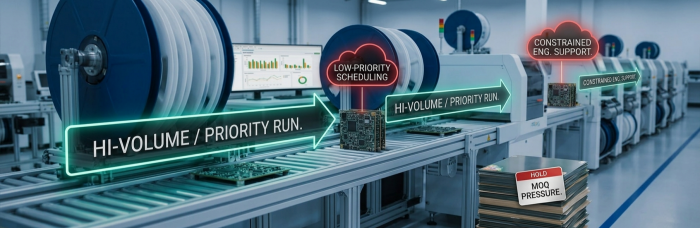
Low-priority scheduling. HMLV lots are slotted into gaps between high-volume runs rather than planned as primary work. Lead times extend, and schedule slippage is common whenever a higher-volume order requires line priority.
Minimum order quantity pressure. To render the changeover economically tolerable, sales teams push buyers toward MOQs exceeding actual program requirements — resulting in excess inventory, obsolescence exposure, or expenditure on unneeded units.(See Low-Volume PCB Assembly — No Minimum Order Quantity for what a genuinely no-MOQ model looks like.)
Constrained engineering support. DFM review, first-article inspection, and process engineering for a 50-unit run receive a fraction of the attention allocated to a 50,000-unit run, even though low-volume, high-mix boards — dense BGA/QFN fields, mixed fine-pitch and through-hole components, ENIG/OSP finish variation — typically require greater engineering judgment per unit, not less.
Price inflation disguised as premium service. Setup and changeover costs are absorbed into unit pricing rather than itemized, so the buyer pays a volume-run price structure for a batch that never realizes volume economics.
These four consequences compound: a delayed, under-resourced order priced as if it were a high-volume run.
Three Structural Advantages of HMLV-Focused EMS Providers
Providers engineered around HMLV production from the outset address these same variables differently — not through superior intent, but through distinct line and organizational design.
Line and process architecture built for changeover, not throughput
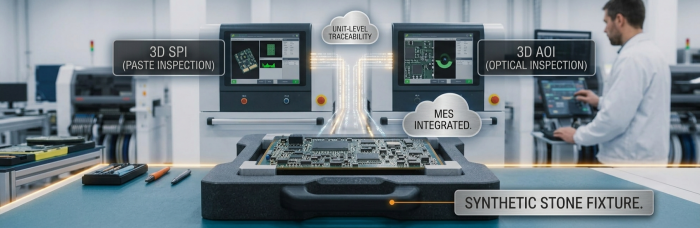
HMLV-focused facilities design equipment selection and workflow around fast, repeatable reconfiguration rather than long, uninterrupted runs. Closed-loop process control — 3D solder paste inspection (3D SPI) linked to 3D automated optical inspection (3D AOI), supplemented by off-line X-ray for BGA/QFN void assessment on new programs — carries proportionally greater weight here than on a stable high-volume line, since each new lot effectively constitutes a new first-article condition. Fixturing engineered for warpage-prone boards, such as synthetic stone fixtures, supports this same requirement: consistent process control across boards that rarely repeat identically.
Engineering-to-program staffing ratio
In an HMLV-native operation, the ratio of process and quality engineers to concurrent active programs is deliberately maintained at a higher level, because engineering judgment — rather than repetition — is what sustains yield stability across constantly changing boards. In practice, this means DFM feedback on a 60-unit medical instrumentation board receives comparable rigor to a substantially larger run, because the organization is not structured around the assumption that engineering attention should scale with unit volume.
Pricing model transparency
HMLV-focused providers typically itemize setup, NPI, and changeover costs separately from per-unit assembly costs, rather than folding them into an inflated blended rate. This allows a buyer to see the actual cost basis of a small batch and to compare quotations on a like-for-like basis, rather than receiving a volume-run rate disguised as a small-batch quotation.
Identifying "Nominal HMLV" Suppliers
Not every provider that markets itself as flexible or small-batch-capable is structurally equipped for it. A few diagnostic questions distinguish genuine HMLV capability from a high-volume operation repositioned for lead generation:
Request the MOQ floor. If the stated minimum order quantity materially exceeds your program's actual requirement, the line remains tuned for volume — the "flexibility" is positioning language layered on a high-volume cost structure.
Ask who conducts first-article and DFM review. If the response is a shared engineering pool rather than a named process engineer with dedicated bandwidth for your board, expect the constrained-support pattern described above.
Ask for a pricing breakdown. A provider with genuine HMLV pricing discipline can present setup and NPI costs separately from unit cost. A provider offering only a single blended per-unit figure is likely absorbing changeover cost the same way a Tier-1 operation does.
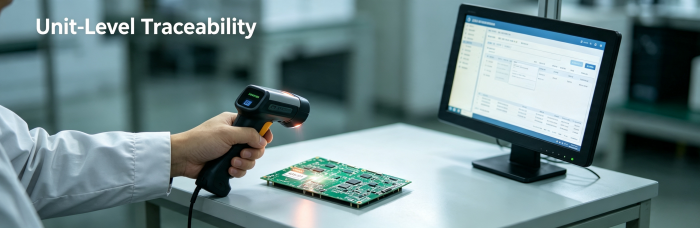
Ask about traceability granularity. HMLV production with mixed part numbers running concurrently through the same facility requires unit-level identification — UID marking, MES-tracked — to prevent cross-contamination of program records on the production floor. A provider that tracks only at the lot level is signaling that its systems were built for fewer, larger, more homogeneous runs.
The Order Profile Best Suited to HMLV-Focused EMS
HMLV-focused providers are generally the better structural fit — not merely a viable alternative — for buyers whose orders fall within this general profile:
Batch size: typically dozens to low thousands of units per lot, rather than tens of thousands
Part number diversity: multiple distinct board programs or revisions active concurrently, rather than a single SKU running for months
Order cadence: frequent reordering with variation between lots — revision changes, component substitutions, mixed technology — rather than a stable repeat build
Engineering intensity: boards requiring DFM input, void inspection, or fixture-specific handling on nearly every new lot, rather than a mature, unattended program
These ranges are illustrative of a category rather than a quotation for any specific program; actual fit depends on the board's technology mix, component count, and inspection requirements.
Closing: A Structural Comparison, Not a Sales Argument
Consider two hypothetical orders for the same general class of board — a semiconductor test interface board, several hundred units, three part-number variants active concurrently, each requiring BGA void inspection and unit-level traceability back to lot records.
Routed through a high-volume-oriented line, that order competes for scheduling priority against runs many times its size, is likely subject to an MOQ exceeding its actual requirement, and receives engineering attention sized for a fraction of what the board's complexity warrants.
Routed through a line architected around exactly this order profile — closed-loop 3D SPI/AOI feedback, X-ray void checks on new programs, MES-based unit traceability, and an engineering team sized to the number of active programs rather than total unit volume — the same order is scheduled as core work rather than overflow, and process controls scale with complexity rather than volume.
The differential is not effort or goodwill on either side. It is what the line and the organization were engineered to do well.
If your program fits this profile — frequent changeovers, mixed part numbers, engineering-intensive builds — it is worth having your bill of materials and process requirements reviewed against a facility structured specifically for that work. PCBCart's HMLV assembly lines are built around this exact order profile; submitting an RFQ is the fastest way to see how your specific board and batch size would be handled.
Ressources utiles
• Traceability from Silicon to System: MES Implementation in Life Sciences Manufacturing
• IATF 16949 PCBA Assembly: Zero-Defect Protocols for Automotive Electronics
• 10 Questions to Ask Any EMS Partner Before Signing: A Technical Due Diligence Framework
• HMLV Electronics Manufacturing: The Future of Low-Volume PCB Assembly


