



A quoted unit price for an industrial IoT assembly answers one question: what does the supplier charge to ship a populated board? It does not answer what the device will cost once it is flashed, connected, installed in a cabinet or on a pole, and expected to stay online for years.
IoT devices carry cost drivers that a standard digital board does not: radio performance, shield-can rework, firmware programming, and truck-roll-level field service. This article lays out an industrial IoT manufacturing TCO framework you can use to compare EMS quotes on equal terms.
Why IoT Devices Need Their Own Cost Model
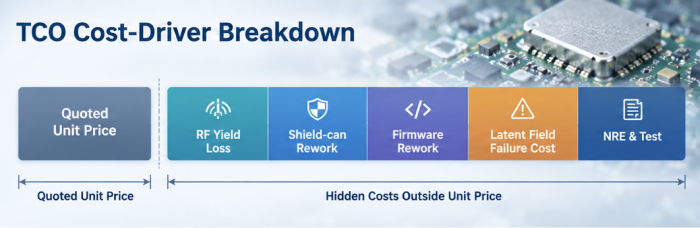
A wireless industrial node combines dense mixed-technology assembly with a radio that must work in an enclosure, near metal, and often in electrically noisy plants. Three cost categories rarely appear on a quote line but routinely dominate the real total:
RF yield loss, including shield-can rework.
Firmware programming failures and the rework they trigger.
Field failures and recalls, where the device is installed somewhere expensive to reach.
Unit price captures none of them.
The Three IoT-Specific Cost Items
RF Yield Loss and Shield-Can Rework
RF sections are sensitive to solder joint quality, paste volume, component placement, and board flatness. A marginal joint on an antenna matching network or RF front-end can produce a unit that powers up and passes basic checks but underperforms in range or throughput.
Shield cans make the problem expensive. Once a can is soldered over an RF section, any defect underneath requires:
Can removal (localized heat on a populated area).
Rework and re-inspection of the covered components.
Can replacement or reattachment.
Retest, and a second thermal exposure for neighboring parts.
The practical lesson is process sequencing: verify the covered area before the shield is attached. Process controls that matter here include controlled paste deposition (jet printing is useful for fine-pitch and mixed-volume RF areas), 3D SPI after printing, and 3D AOI after placement and reflow. Catching a defect at AOI costs a fraction of catching it after the can is on.
Firmware Programming Failures
Programming is often priced as a small per-unit fee and then ignored. The cost shows up when it fails:
Units that fail to flash, or flash with the wrong image or configuration.
Units that must be reflashed after a firmware revision, requiring retrieval from WIP or finished stock.
Mixed-revision lots shipped to the field, with no way to tell which device carries which build.
In an HMLV environment with frequent revisions, version control is the real risk. Unit-level traceability helps: a Smart MES that assigns a UID to each unit, with laser marking, lets you tie a serial number to its build record, so a firmware or process issue can be scoped to specific units rather than a whole shipment. Confirm with any supplier exactly which programming results are captured against the UID in your workflow.
Field Failures and Recall Exposure
A wireless connectivity fault in the field is not a bench rework. It can involve diagnosis, a site visit, downtime for the end customer, and replacement logistics. For devices mounted in remote or hard-to-access industrial locations, the service visit often costs more than the device.
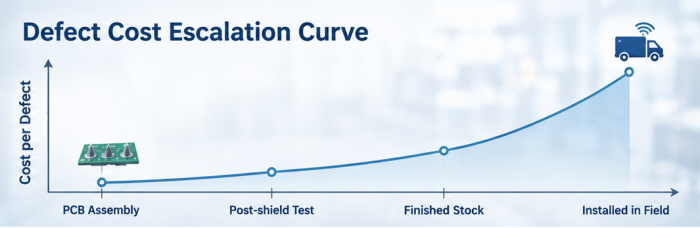
Industry literature on quality economics consistently makes the same point: the cost of correcting a defect rises sharply the later it is found in the product lifecycle. Treat the field as the most expensive place to discover a manufacturing escape.
A Total-Cost Framework for IoT Devices
Use this structure when evaluating an IoT device total cost framework:
TCO = Unit Price + NRE + RF-Specific Verification + Firmware Programming + Latent Field-Failure Cost
| Component | What to define | Where cost hides |
|---|---|---|
| Unit price | BOM, assembly, standard inspection | Assumptions about yield and rework |
| NRE | Stencil/fixtures, programming setup, test development | Fixture rework when the design changes |
| RF-specific verification | Scope of RF checks, pass/fail criteria, who supplies the test method | Omitted from quote, discovered in the field |
| Firmware programming | Per-unit fee, image control, failure handling, reflash policy | Reflash labor, mixed revisions |
| Latent field-failure cost | Probability × cost per incident (your estimate) | Truck rolls, downtime, brand damage |
For the last row, use your own installed-base assumptions. A simple expected-cost model is: failure rate assumption × units deployed × cost per field incident. Nothing here requires supplier data; it requires that you decide what a field incident costs you.
How Low-Price Quotes Transfer Risk
This is a methodology pattern, not a claim about any particular supplier or customer.
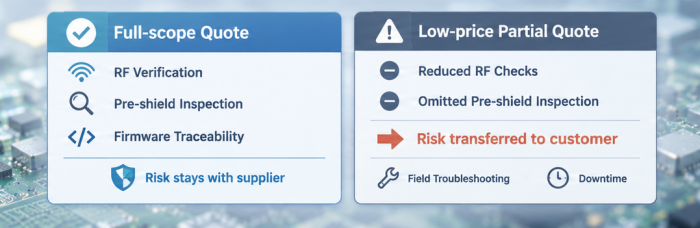
When a quote is far below the others, ask which scope was removed to reach that price. In IoT assembly, a common pattern is:
The RF-specific verification step is excluded or reduced to generic functional checks, because RF-specific verification needs fixtures, test procedures, and cycle time.
Wireless performance escapes the factory. Units pass basic power-on and communication checks but have marginal RF performance.
Problems surface as intermittent field behavior: dropped connections, reduced range, inconsistent pairing. These are hard to reproduce and easy to misattribute to firmware or the installation environment.
The cost transfers to you: diagnosis, replacement, reflash, and customer relationship repair, with the supplier's purchase order long since closed.
The unit price did not disappear; it moved from the supplier's cost line to yours, and it grew in transit.
Questions that expose this pattern:
What RF-related checks are included in the quoted price, and which are optional?
Is inspection performed before shield cans are attached?
How are programming results recorded, and what happens to units that fail?
What traceability exists from field serial number back to the build record?
Note that manufacturing-record capabilities such as inspection data and UID traceability are process controls. They are not metrology or calibration accreditations, and they do not replace your own RF compliance testing at an accredited lab.
IoT Device Total Cost Comparison Template
When you line up quotes, ask every supplier to answer the same set of questions, one cost item at a time. A quote that leaves an item unanswered has not made it free; it has left it unpriced.
Unit price at the quoted volume: Confirm what yield and rework assumptions sit behind the number.
NRE: Ask for stencil, fixture, programming setup and test development to be listed separately, along with who pays when a design revision forces fixture rework.
RF-specific verification: Ask what is included, what the pass/fail criteria are, and who supplies the test method. Anything marked "optional" belongs in your total.
Pre-shield-can inspection: Ask whether the covered area is inspected before the can is attached, and how shield-can rework is charged if a defect is found later.
Firmware programming: Ask for the per-unit fee, how image and configuration versions are controlled, and what happens to units that fail to flash or need a reflash.
Traceability: Ask what is recorded against each UID and how long the records are retained.
Workmanship warranty: Ask for the terms in writing. Do not assume them.
Your own field-incident cost: Add your estimate of what one connectivity failure in the field costs you. This is the one number no supplier can fill in for you.
Add these answers up per supplier, and the lowest unit price may no longer be the lowest total cost.
Process Controls That Reduce IoT-Specific Cost
For a high-mix, low-volume IoT build, the controls that most directly reduce rework and escape risk are:
Jet printing and 3D SPI: repeatable paste deposition on mixed-pitch boards, with measured feedback.
3D AOI in a closed loop with SPI: catches placement and solder defects before they get covered by shields.
Off-line X-ray: inspects hidden joints on BGA and QFN parts, including voiding, with oblique-angle capability for joint-quality review.
Synthetic stone fixtures: support thin or asymmetric boards through thermal processes to limit warpage.
Automated selective wave soldering with N2 protection: for through-hole connectors and terminals common on industrial devices.
Smart MES with UID and laser marking: unit-level build records for scoping any later issue.
None of these replaces a clear definition of RF test scope in your documentation. They reduce the number of defects that reach that step.
Request an IoT Device Total Cost Comparison
If you are sourcing an industrial IoT device and comparing quotes, the unit price is the easiest number to get and the least informative one.
Submit your RFQ with your BOM, Gerber and assembly data, firmware programming requirements, and any RF test procedure or acceptance criteria you use. Ask us for the IoT device total cost comparison sheet, and we will help you structure the quote so RF, programming, and traceability scope are visible line by line rather than buried in a single number. PCBCart provides PCBA assembly services for industrial automation, life sciences, and semiconductor test equipment applications.
Request an IoT Assembly Quote
Helpful Resources
- Total Cost of Ownership (TCO) in Electronics Manufacturing Explained
- Battery-Powered Industrial IoT Sensor PCBA: Low-Power Design Assembly Considerations
- Conformal Coating Strategies for Industrial IoT Gateway Boards in Harsh Environments
- 10 Questions to Ask Any EMS Partner Before Signing: A Technical Due Diligence Framework


