



1. Environmental Threat Matrix for Industrial IoT Gateway PCBs
Industrial IoT gateways differ drastically from consumer networking hardware, as they are routinely deployed in unconditioned outdoor cabinets, factory floors, and remote field edge stations. These harsh operating environments expose bare printed circuit board assemblies to four dominant destructive factors: extreme temperature cycling ranging from -40°C to +85°C, high-humidity condensation, salt spray corrosion, and sustained mechanical vibration. Without purpose-built conformal coating protection, subtle progressive degradation occurs on board surfaces and solder joints, gradually triggering circuit malfunctions and drastically shortening overall device service life.
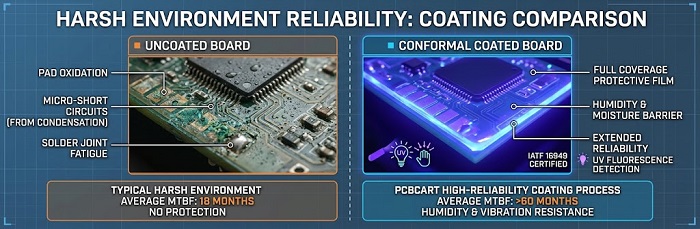
Field reliability data of mass-deployed industrial IoT gateways verifies a clear MTBF gap between uncoated and coated boards. Bare PCBA units operating in standard harsh industrial environments record an average MTBF of only 18 months, with dominant failure causes including pad oxidation, micro-short circuits from condensed moisture, and component solder joint fatigue accelerated by environmental corrosion. In contrast, PCBA with optimized conformal coating process implementation extends the average MTBF to over 60 months, meeting the long-term stable operation requirements of industrial edge devices.
To mitigate such reliability risks, standardized and repeatable coating processes are essential. As an IATF 16949-certified EMS provider, our process protocols follow rigorous high-reliability manufacturing standards that exceed typical reliability requirements for non-implantable industrial and medical electronics, stabilizing coating quality and ensuring consistent batch performance for high-mix low-volume IoT gateway production projects.
2. Conformal Coating Material Selection for Industrial IoT Gateway Scenarios
Material selection is the core of conformal coating reliability, directly affecting moisture resistance, signal stability, maintainability and environmental adaptability of IoT gateway boards. Four mainstream coating materials—Acrylic (AR), Polyurethane (UR), Silicone (SR), and Epoxy (ER)—have distinct performance differences in edge gateway application scenarios, especially in moisture permeability, rework difficulty, and millimeter-wave radio frequency signal attenuation. The following scoring table quantifies their adaptability for industrial IoT gateway PCBA:
| Coating Material | Moisture Vapor Transmission Rate | Rework Difficulty | RF Signal Attenuation (Millimeter-Wave Module) | Vibration Resistance | Scenario Adaptability Score (1-10) |
|---|---|---|---|---|---|
| Acrylic (AR) | Low | Easy (solvent removable) | Minimal | Medium | 9.2 |
| Polyurethane (UR) | Ultra-Low | Moderate | Very Low | High | 8.5 |
| Silicone (SR) | Medium | Simple (mechanical stripping) | Slight High-Frequency Attenuation | Ultra-High | 7.8 |
| Epoxy (ER) | Ultra-Low | Very Hard (non-reworkable) | Obvious Attenuation | High | 6.0 |
Given the unique structural and functional characteristics of industrial IoT gateways—especially integrated millimeter-wave communication modules that are highly sensitive to dielectric interference—material selection must balance corrosion resistance, environmental stability, and signal transmission accuracy. Based on the performance data above, acrylic and polyurethane coatings stand out as the optimal choices for mainstream gateway designs. They deliver robust anti-condensation and anti-corrosion protection while inducing minimal high-frequency signal attenuation, ensuring stable data transmission for edge communication functions. Silicone coatings offer superior vibration resistance but are limited to non-RF board regions due to slight millimeter-wave signal interference. Epoxy coatings, despite excellent moisture resistance, are not recommended for gateway core boards, as their fully cured structure makes rework nearly impossible and causes obvious attenuation of high-frequency signals.
3. Conformal Coating Process Comparison & Precision Control
Even with optimal coating material selection, improper coating processes can negate material performance and introduce new reliability risks. Traditional full-board spray coating, the conventional low-cost process, has prominent limitations for high-precision IoT gateway boards.
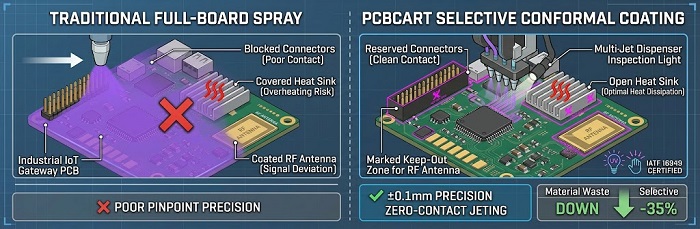
Traditional full-board spray coating has prominent defects in IoT gateway board processing: it cannot accurately shield connectors, heat dissipation fins, test points and RF antenna clearances, easily causing functional failure such as poor plug-in contact, heat dissipation blockage and antenna signal deviation. Selective coating effectively solves these pain points through programmed precise positioning and quantitative coating.
We adopt the MYCRONIC Jet Printer & Dispenser platform for selective conformal coating processing, with a positioning accuracy of ±0.1mm. This high-precision jet dispensing method achieves zero-contact coating, completely avoiding solder pad and antenna pad contamination on high-density fine-pitch gateway boards. Compared with traditional spray coating, selective coating reduces material waste by 35% while ensuring full coverage of vulnerable areas such as component pins and solder joints.
Beyond precise coating execution, targeted shielding design is critical to preserve board functionality. We develop customized shielding schemes based on each gateway board’s design files, covering external interface connectors, functional test pads, and heat dissipation openings with high-temperature resistant fixtures prior to coating. After coating and full curing, fixtures are removed cleanly without adhesive residue, safeguarding the electrical connectivity and heat dissipation performance of key functional zones.
4. IPC-CC-830B Standard Compliance & Quality Inspection Criteria
Precision coating application must be paired with standardized inspection protocols to ensure long-term field reliability. All our conformal coating workflows for industrial IoT gateway PCBA strictly adhere to the IPC-CC-830B industry acceptance standard, with quantifiable specifications for coating thickness, defect classification, and batch verification methods.
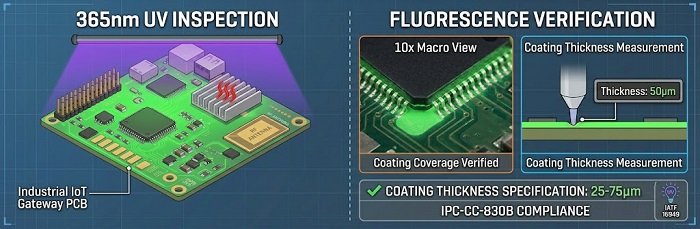
All conformal coating processes for industrial IoT gateway PCBA strictly comply with the IPC-CC-830B industry acceptance standard, with clear quantitative specifications for coating thickness, defect judgment and inspection methods. For the most widely used acrylic coating for gateway boards, the standard coating thickness is controlled within 25–75μm. Too thin a coating cannot form a complete protective film, while excessive thickness will lead to cracking under temperature cycling and affect component heat dissipation.
In terms of defect control, IPC-CC-830B clearly defines unqualified defects: coating bubbles larger than 0.5mm, pinhole defects in high-density circuit areas, and local missing coating on solder joints and component edges. For batch quality inspection, we use 365nm UV fluorescence detection technology. The conformal coating material presents obvious fluorescence under UV excitation, which can quickly and intuitively verify board-wide coating coverage and accurately identify tiny missing coating areas invisible to the naked eye.
To lock in process consistency across high-mix batches, we leverage a smart MES system with UID component-level traceability. All key coating parameters—including coating thickness, curing temperature, and process duration—are recorded in real time, enabling full lifecycle traceability for every gateway board. This traceable workflow aligns with IATF 16949 quality system requirements, ensuring repeatable high-quality coating results.
5. Rework Process & Secondary Coating Adhesion Verification
High-mix low-volume IoT gateway manufacturing inevitably requires targeted rework and secondary coating for prototype iterations and batch repairs. Improper rework often causes coating delamination, residual contamination, or reduced adhesion, which compromise long-term reliability in harsh environments. To address this pain point, we adopt two differentiated coating removal processes for different board scenarios.
In HMLV industrial IoT gateway projects, board rework and secondary coating scenarios are common. We adopt two targeted removal processes for failed coatings. For local coating defects on precision RF modules and fine-pitch components, hot air local removal is used with a controlled temperature of 120–150°C to avoid thermal damage to core components. For large-area invalid coatings on non-precision areas, chemical solvent removal is adopted to improve removal efficiency while ensuring no residual corrosive substances on the board surface.
After defect removal and professional surface activation cleaning, qualified secondary conformal coating is applied. Since reworked board surfaces differ from pristine factory substrates, adhesion performance becomes the core indicator of rework quality. We strictly implement the ISO 2409 cross-cut test method for adhesion verification, only approving finished boards that achieve Grade 0–1 adhesion with no peeling or edge warping. This standardized verification effectively prevents coating delamination and failure during long-term field operation.
6. DFM Design Optimization for Harsh-Environment IoT Gateway Boards
Coating process reliability is not solely dependent on manufacturing execution; front-end PCB DFM design fundamentally determines coating yield and long-term protection effectiveness. Inappropriate board layout often creates uncoatable dead zones, hidden contamination risks, or signal attenuation issues that cannot be fully remedied by post-processing optimization. Combining years of industrial IoT PCBA manufacturing and coating experience, we have summarized three targeted DFM optimization rules for harsh-environment gateway boards:
Conformal coating reliability depends not only on process control but also on front-end PCB design optimization. Combined with years of industrial IoT PCBA manufacturing experience, we summarize 3 core design suggestions for gateway boards suitable for harsh environments:
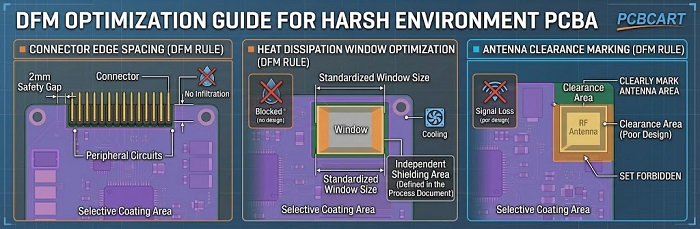
Connector edge spacing design: Reserve a minimum 2mm safe spacing between external connectors and peripheral circuits. It avoids coating infiltration into connector pins during selective coating, ensuring plug-in stability and long-term contact reliability.
Heat dissipation window optimization: Standardize the size and edge indentation of board-level heat dissipation windows, and mark independent shielding areas in process documents. This prevents coating coverage from blocking heat dissipation channels and causing component overheating failure in high-temperature operating environments.
Antenna clearance marking: Clearly mark millimeter-wave antenna and RF circuit clearance areas in design drawings, and set forbidden coating zones in the process system to eliminate high-frequency signal attenuation risks fundamentally.
7. Free Technical Support & Evaluation
Most field failures of industrial IoT gateway boards in harsh environments stem from mismatched coating materials, unoptimized coating processes, or unreasonable PCB layout designs, rather than component quality issues. Our engineering team has accumulated mature, field-verified conformal coating solutions for high-reliability industrial control and edge communication PCBA, with standardized processes and precision manufacturing capabilities tailored to HMLV project characteristics.
Poor conformal coating matching and unreasonable process design are the main causes of low MTBF and frequent failures of industrial IoT gateway boards in harsh environments. Our engineering team has accumulated mature coating process solutions for various high-reliability industrial control and edge communication boards, with standardized process systems and precise process control capabilities.
If you are developing or mass-producing industrial IoT gateway boards, request a FREE DFM Review from our senior process engineers to obtain targeted conformal coating material selection and process optimization suggestions. You can also download our EMS Supplier Evaluation Scorecard to conduct a comprehensive reliability assessment of your current board manufacturing and coating processes.
Helpful Resources
• General Aspects You Should Know about Conformal Coating Applied on PCB
• Printed Circuit Boards Assembly Process
• Design PCBs to Better Take Advantage of PCBCart's PCB Assembly Capabilities
• Antenna Design Considerations in IoT Design
• Guidelines for RF and Microwave PCB Design
• Advanced PCB Assembly Service


