



NRE (non-recurring engineering) fees in PCBA assembly cover the one-time engineering setup work a board needs before production can start — stencil or paste-deposit programming, custom fixture fabrication, first article validation labor, and inspection program development. Unlike per-unit assembly cost, NRE is billed once per board revision, not per piece.
Non-recurring engineering fees are one of the most misunderstood line items on an EMS quote. In high-mix, low-volume (HMLV) PCBA programs — where board designs, fixturing, and process parameters change frequently across a supplier's production floor — NRE isn't a padding charge. It's the cost of building the process infrastructure a specific board needs before mass production starts. The problem is that "NRE" means different things at different assembly houses, and a low NRE line on one quote may simply mean a step was moved elsewhere, or skipped.
What NRE Fees Typically Cover
Stencil Fabrication
Solder paste stencils are board-specific and non-reusable across designs. For programs using jet-printing/dispensing platforms such as a MYCRONIC jet printer, stencil-equivalent programming still requires deposit-pattern development and calibration specific to the board's pad geometry, so this engineering time is billed similarly even when a physical stencil isn't cut. Either way, this is a one-time, board-specific cost that doesn't carry over to the next revision without re-verification.
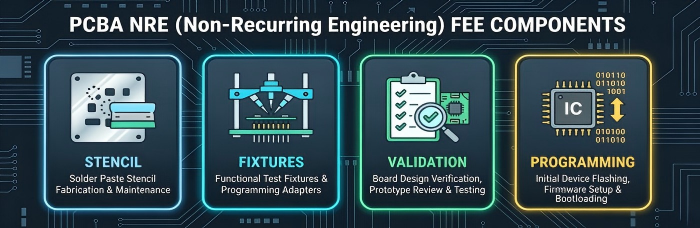
Fixture Fabrication
HMLV boards frequently need custom test or process fixtures — pogo-pin ICT fixtures, selective soldering pallets, or warpage-control tooling. Suppliers using synthetic stone fixture plates for warpage control, for instance, still need to machine or configure that fixture to the specific board outline and component keep-out zones. Fixture NRE is almost always tied to board revision: a mechanical change to the PCB outline or connector placement typically triggers a re-fixture charge.
First Article Engineering Validation Labor
This covers the engineering hours spent proving the process before production release: reflow profile development and validation on equipment like a JTR-1200D-N reflow oven, selective wave soldering parameter setup on nitrogen-protected platforms, and first article inspection (FAI) against the approved drawing package. For BGA/QFN-heavy boards, this stage often includes voiding evaluation via X-ray to confirm the profile meets acceptance criteria before the lot proceeds.
Programming and Debug
SPI, AOI, and X-ray inspection systems all require board-specific programs — solder paste volume windows for 3D SPI, component library and defect-threshold configuration for 3D AOI, and voiding/placement inspection routines for X-ray. MES UID traceability configuration and laser marking parameters are also typically programmed once per board and reused across the production run, which is why this cost is billed as NRE rather than per-unit.
Common NRE Disputes: One-Time Charge vs. Amortized Into Unit Price
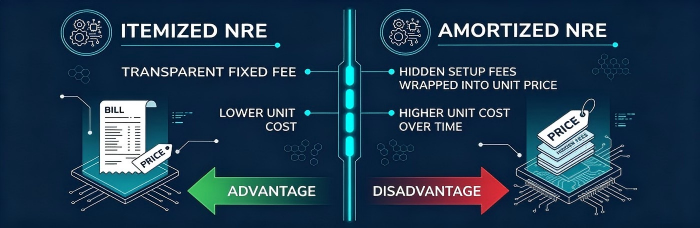
The friction usually isn't about whether these steps happen — it's about how they're billed. Two structures are common, and neither is inherently wrong, but they produce very different-looking quotes:
Billed as a separate one-time NRE line. The unit price reflects only recurring material and labor cost; NRE is paid once, typically at first order or PO release.
Amortized into the per-unit price across a projected order quantity. The NRE total is divided across an assumed volume and folded into piece price, making NRE effectively invisible on the quote.
This matters most when comparing quotes side by side. A supplier with a "$0 NRE" line and a higher unit price hasn't eliminated the cost — they've moved it. For HMLV programs where volumes are inherently uncertain, amortized NRE can become a problem if the projected quantity isn't reached: the buyer ends up paying more per unit than planned, or renegotiating mid-program. A separately itemized NRE is generally easier to audit, even if it looks larger upfront.
A second dispute point is re-NRE on revisions. Minor BOM substitutions (approved alternates) typically shouldn't trigger new stencil or fixture charges, but footprint, outline, or connector changes usually do. Ask suppliers to define, in writing, what class of ECO triggers re-fixturing versus what's covered under existing tooling.
What a Low NRE Quote May Be Hiding
An unusually low NRE figure relative to comparable quotes is a signal to ask more questions, not a reason to celebrate. Two shortcuts show up most often:
Compressed first article validation. Skipping or abbreviating reflow profile trials, selective soldering parameter tuning, or SPI/AOI program development to save engineering hours shifts risk downstream — defects surface in production rather than being caught before release.
Skipped or informal FAI review. A first article that isn't measured against the approved drawing, or isn't reviewed with documented sign-off, removes the checkpoint that's supposed to catch tooling or programming errors before a full lot runs.
Neither of these is always visible in a quote line item. The way to surface them is to ask what the NRE fee specifically includes in terms of deliverables — not just dollars.
How to Request an NRE Breakdown at RFQ Stage
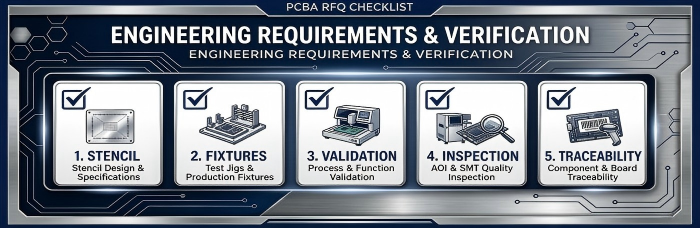
To compare quotes meaningfully, ask suppliers to itemize NRE rather than presenting a single lump sum. A useful RFQ request typically asks for:
Stencil or paste-deposit programming cost, itemized separately from other tooling
Fixture fabrication cost, with a note on what design changes would require re-fixturing
First article engineering hours, including reflow/soldering profile development
Inspection programming cost (SPI, AOI, X-ray) as a discrete item
MES/traceability setup and laser marking programming, if applicable
Whether any portion of NRE is refundable, waived at volume thresholds, or credited against future orders
Suppliers who can produce this breakdown on request are generally the ones actually tracking these costs internally — which is itself a useful signal about process maturity.
Get an Itemized NRE Quote
Comparing suppliers on unit price alone hides where the real cost is. If you want a quote that separates stencil/programming, fixture, first article validation, and inspection programming into distinct line items — so you know exactly what you're paying for and why — submit your BOM, Gerber files, and assembly drawings and PCBCart's engineering team will return a detailed, itemized breakdown.
Submit Your Project for an Itemized Quote →
Helpful Resources
• Top HMLV EMS Providers: What to Consider When Choosing
• DFM Audit Checklist for Industrial PCBA: 38 Design Rules That Cut Rework Rate by Over 40%
• Free PCB DFM Check and Checklist for PCB Assembly


