



Proactive multi-sourcing is the practice of qualifying a second, functionally equivalent component vendor before a supply disruption occurs — validating electrical parameters, process compatibility, and lot changeover performance during the design phase so an alternate source is production-ready when needed.
Component shortages force reactive substitution decisions under deadline pressure — cross-referencing alternates, requesting engineering waivers, and validating replacements against a compressed schedule. That reactive posture is a separate problem from the one addressed here: designing multi-source flexibility into the BOM before a shortage occurs, so that a second qualified vendor is already validated and ready to run when the primary source falters.
For long-lifecycle medical electronics — devices with 7–10+ year production commitments — proactive multi-sourcing isn't a cost-optimization exercise. It's a supply continuity requirement built into the design phase, with regulatory implications that differ meaningfully from a same-day emergency swap.
Why Multi-Vendor Component Strategy Requires Design-Stage Planning
A dual-source strategy implemented after a part goes end-of-life is really just an accelerated substitution process — the same activity as shortage response, just with slightly more lead time. True multi-sourcing means the second vendor's part number is already qualified, documented, and sitting in the approved manufacturer list (AML) before it's ever needed.
This distinction matters because medical device component changes typically trigger a documented change control process regardless of urgency. Doing that qualification work under shortage pressure means compressing validation, risk assessment, and (where applicable) regulatory notification into a timeline the crisis dictates. Doing it during initial design or an early revision cycle means the qualification work happens on the OEM's schedule, with full test data already on file when the change is eventually executed.
Unlike reactive shortage mitigation — the emergency-response scenario covered separately for component obsolescence and allocation events — this proactive framework front-loads the qualification work before disruption hits, rather than compressing it into a crisis timeline.
Dual-Source Component Qualification Process for Medical PCBA
Qualifying a second source isn't a datasheet parameter check. A rigorous qualification process for medical PCBA components typically works through three layers:
Electrical Parameter Comparison
Absolute maximum ratings and operating windows — voltage, current, thermal derating curves compared side by side, not just typical values
Tolerance stack-up — particularly for passives feeding into precision analog paths (reference voltages, ADC input dividers, filter networks) where a tighter or looser tolerance on the alternate part shifts circuit behavior
Parametric drift over temperature and time — relevant for components in signal-chain or timing-critical positions
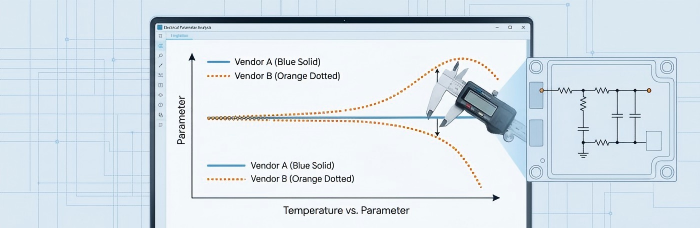
Package-level parasitics — ESR, ESL, and junction capacitance differences between vendors can matter more than the primary spec sheet number, especially at higher switching frequencies
Process Compatibility Verification
A part can be electrically equivalent and still behave differently on the line. This step confirms:
Reflow profile compatibility — MSL rating, peak body temperature tolerance, and moisture sensitivity classification must align with the qualified profile run on the JTR-1200D-N reflow oven; a vendor's part with a lower MSL rating or tighter thermal ceiling can force a profile split

Solderability and lead finish consistency — particularly relevant when the alternate source uses a different finish (e.g., matte tin vs. NiPdAu) that affects wetting behavior under N2-protected selective soldering
Print and placement parameters — footprint tolerances checked against the existing stencil design and MYCRONIC jet-printed paste deposition pattern; a body outline that's nominally "pin-compatible" can still require stencil aperture adjustment
Inspection recipe validity — 3D SPI and 3D AOI programs are typically built around the golden sample's optical signature (body height, marking contrast, lead visibility); a second-source part with a different mold compound finish or marking method may need a supplemental inspection recipe rather than reusing the primary part's program as-is
Lot Changeover Testing
Before the alternate part is released into full production, a controlled changeover run validates the qualification on the actual line:
A pilot lot assembled with the alternate component under production process parameters, not lab conditions
First-article inspection against the same acceptance criteria as the primary source
For BGA/QFN packages in particular, off-line X-ray inspection to confirm void percentage and solder joint formation are consistent with the primary source's established baseline — this is where oblique-angle X-ray capability matters most, since standard top-down imaging can miss marginal joint conditions on the outer ball rows
Functional and, where applicable, environmental stress screening on the pilot units before the alternate is added to the AML as a released source
Designing BOM-Stage Space for Multi-Sourcing
Reserving multi-source flexibility is a design rule discipline applied before layout freeze, not a retrofit:
Footprint compatibility as a selection criterion — where multiple vendors offer functionally similar parts, favor package outlines with published cross-vendor footprint compatibility (common in passives and many standard logic families) over parts where only one vendor's exact body size exists
Pin-compatible alternates flagged at BOM creation — for ICs, identifying pin-compatible second sources at the schematic stage (even if not immediately qualified) avoids a layout respin later if the qualification decision comes after tooling is already cut
Avoiding single-source-only architectures where alternatives exist — this applies most directly to commodity passives, standard logic, and common connector families; for genuinely single-source components (certain ASICs, specialized sensors), the mitigation shifts from dual-sourcing to lifecycle monitoring and strategic buy planning instead
Documenting footprint tolerance windows — capturing the acceptable pad geometry range in the BOM notes so a future alternate part's mechanical drawing can be checked against a defined envelope rather than re-deriving compatibility from scratch

Regulatory Communication Points for Multi-Source Changes
Medical device manufacturers evaluate component-level changes through their own design change control procedures, generally aligned with frameworks like FDA 21 CFR Part 820 design controls or equivalent international QMS structures. From an EMS partner's side, the touchpoints that typically require coordination are:
Change notification timing — providing the OEM's quality team with qualification data (electrical comparison, process validation, X-ray inspection results) early enough for their internal risk assessment, rather than at the point the primary source is already depleted
Documentation package alignment — qualification records, first-article inspection reports, and pilot lot X-ray data formatted to support the OEM's own design history file (DHF) entry for the component change, since the OEM — not the EMS provider — typically owns the regulatory submission decision (e.g., whether a change requires a new 510(k) or falls under a documented internal change)
Traceability continuity — confirming that Smart MES UID traceability and laser marking capture the alternate vendor's lot and date code data with the same granularity as the primary source, so post-market surveillance queries aren't disrupted by the source change
Class-dependent review depth — higher-risk device classifications generally warrant more conservative treatment of even "equivalent" component substitutions, since the OEM's risk management file may weight component-level changes differently based on the device's risk classification
Implementation Checklist
Identify BOM lines with single-source risk exposure (long lead time, sole-source ICs, allocation-prone passives)
Screen candidate alternates for footprint and pin compatibility before requesting samples
Run electrical parameter comparison against the primary source's qualified datasheet values
Verify process compatibility — MSL, reflow profile, solderability — against existing line parameters
Execute a pilot changeover lot with first-article inspection and X-ray void analysis
Package qualification data for the OEM's design change control review
Release the alternate to the AML with documented traceability parity in MES
Multi-sourcing that's qualified before it's needed converts a shortage into a sourcing decision instead of a production stoppage. If you're carrying single-source risk on a BOM for a long-lifecycle medical program, submit it to PCBCart for a multi-source feasibility assessment — we'll flag the highest-risk lines and outline what qualification would involve for each.
Helpful Resources
· First Article Inspection & Sample Build Protocol for Medical Device NPI
· Managing Fine-Pitch QFN/BGA Rework Risk on Medical Monitoring Device PCBA


