



Clarifying the Division of Responsibility
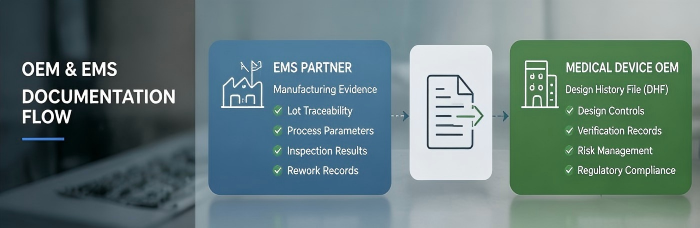
In short: A PCBA assembly partner supplies manufacturing-process evidence — lot traceability, process parameters, inspection results, and rework records — that a medical OEM's quality team incorporates into its own Design History File. The assembly partner does not compile, own, or submit the DHF itself; that responsibility remains with the OEM as the device's design authority.
Medical device OEMs sourcing PCBA assembly for diagnostic, monitoring, or therapeutic subassemblies often ask a version of the same question during supplier qualification: can you help us compile our Design History File? The honest answer requires a distinction that's easy to blur but worth stating precisely upfront.
An assembly partner does not build, own, or submit a client's DHF. Under FDA regulation, a Design History File is a compilation of records that describes the design history of a finished device, and the manufacturer of record is responsible for establishing and maintaining that file for each device type it produces. That responsibility sits with the OEM, since the OEM holds design authority and regulatory accountability for the finished device — not the contract manufacturer building its subassemblies.
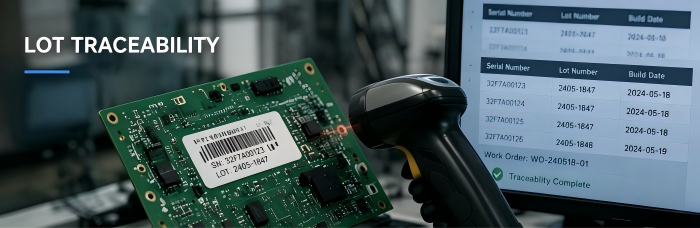
What an EMS partner can provide is the underlying manufacturing evidence an OEM's regulatory or quality team needs to pull into its own DHF structure: lot traceability data, process parameters, inspection results, and rework records generated during assembly. This is a supporting-records relationship, not a document-authoring one. The EMS partner supplies raw, verifiable data; the OEM's design controls and quality organization decide how that data maps into DHF sections, verification records, or device master record content. For a closer look at how that traceability data is structured end-to-end, see Traceability from Silicon to System: MES Implementation in Life Sciences Manufacturing.
The distinction matters for audit purposes too. FDA reviewers and notified-body auditors expect a clear chain of custody for manufacturing records — one that shows the OEM actively curating and referencing supplier-generated data, not treating a contract manufacturer's output as a finished regulatory submission in itself.
Manufacturing Records That Typically Feed Into a DHF
Formats vary by OEM quality system, but the manufacturing evidence regulatory teams commonly draw from an assembly partner falls into four categories.
Lot and Batch Traceability
Every PCBA build should trace to a specific lot: the assembly work order, board serialization or UID, and the incoming component lot numbers used on that build. For subassemblies feeding a finished medical device, this is what lets an OEM answer a field-issue or complaint investigation with an exact list of affected component lots — not an approximate date range.
Process Parameters
Auditors increasingly expect evidence that assembly parameters were controlled, not just that a device passed final test. Depending on the process route, relevant records can include:
Reflow oven profile data — temperature zones, dwell time, peak temperature
Selective soldering parameters — nitrogen atmosphere conditions, solder pot temperature, dwell time per joint
Dispensing or jet-printing volumes and placement coordinates for fine-pitch or COB processes
SPI (solder paste inspection) volumetric and offset data captured pre-reflow
These logs demonstrate that the process ran within a validated window — the manufacturing-side evidence an OEM's own IQ/OQ/PQ documentation typically references. The same lot-level logic extends upstream to incoming materials — see Are the Components Genuine, and How Is Authenticity Verified? for how date-code and lot traceability gets established before a component ever reaches the line.

Inspection Results
Objective inspection data, rather than a bare pass/fail disposition, is the more useful format for DHF-supporting purposes:
3D AOI results with defect classification, not summary yield percentages alone
X-ray inspection records for BGA, QFN, or other hidden-joint packages, including void percentage data where joint voiding is a reliability concern
Final electrical or functional test logs tied to a specific unit serial number
Rework and Nonconformance Records
Where rework occurred, the record should capture what was found, what corrective action was taken, and who performed and verified it. OEM quality teams generally want rework records tied to the same lot/UID traceability as the original build, so a reworked unit's history stays fully reconstructable.
Structuring the Documentation Agreement With Your EMS Partner
The most common gap isn't that manufacturing records don't exist — it's that retention periods, formats, or retrieval processes were never agreed on before production started, and the mismatch only surfaces during an audit or field complaint years later. A few points are worth settling explicitly, in writing, before the first production run.
Retention period. Medical device record retention often extends well beyond the device's typical service life. State the duration in years — not "as long as needed" — and confirm what happens to records if the manufacturing relationship ends.
Record format and structure. Decide whether records arrive as structured MES exports (CSV, database extract) tied to UID/serial number, or as static PDF reports per lot. Structured exports are generally easier for an OEM's document control system to index against DHF sections; static reports are easier to archive as-is but harder to query later.
Retrieval turnaround during an audit. Agree on a realistic timeframe for the EMS partner to retrieve historical records on request. This should be negotiated as an actual, confirmed capability — not assumed as an industry default.
Change control notification. If the EMS partner changes a component source, a process parameter, or an inspection method, the OEM's design control system needs to know — that change may trigger its own re-verification or DHF update. This should be a defined contractual obligation, not an informal courtesy.
Quality System Basis for These Records
It's worth being precise about what underlies these traceability capabilities. Lot tracking, process parameter logging, and inspection recordkeeping are standard outputs of a disciplined quality management system built around process control and traceability — capabilities that transfer directly to medical-adjacent electronics manufacturing without requiring a device-specific certification to exist. Before qualifying any assembly partner on this basis, it's worth running through 10 Questions to Ask Any EMS Partner Before Signing to verify those capabilities go beyond a certificate check.
That said, these records should not be mistaken for a device-specific quality certification. An EMS partner's ability to generate detailed, auditable manufacturing records reflects the maturity of its process controls and documentation discipline — not a regulatory endorsement of the finished medical device itself. OEMs should treat manufacturing-side traceability records as one input into their own design-control and risk-management documentation, which remains their regulatory responsibility regardless of which contract manufacturer produces the physical assembly.
Getting the Documentation Scope Right Before Production Starts
The practical failure mode isn't a missing capability — most established EMS providers can generate lot traceability, process logs, and inspection data. The failure mode is an undefined agreement about what gets delivered, in what format, and for how long it stays retrievable. That conversation belongs in supplier qualification, not after an audit notice arrives.
If you're evaluating a PCBA partner for a medical-adjacent program and want to scope out exactly which manufacturing records your quality team would need — and in what format — PCBCart's engineering team can walk through the documentation package available for a specific build, including MES traceability structure, inspection record formats, and retention terms, before you commit to a production run.
Helpful Resources
● Why Precision Matters: Choosing PCBCart for Medical PCBA Services
● MES Traceability Architecture for IEC-Regulated Industrial Electronics
● How 3D SPI and 3D AOI Reduce Escape Defects in Medical SMT Assembly
● 5 Questions to Ask Your EMS Provider Before Starting a High-Mix Project


