



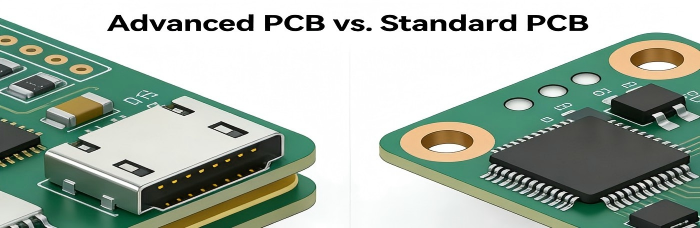
The developments of printed circuit boards (PCBs) reflects the fast technological improvements and the increases in needs in diverse industries. Being the basic component of electronic devices, PCBs serve as a physical platform and electrical inter connector to electronic components. The standard PCBs which previously controlled the market are however being supplemented not replaced by their more advanced counterparts, responding to the growing needs of greater performance, miniaturization and complexity. This paper will critically examine the variations between the advanced PCBs and the standard PCBs, the features, uses and the manufacturing process.
Understanding Standard PCBs
Single or dual copper-layers that are laminated on a non-conductive substrate, such as FR-4, commonly constitute standard PCBs. FR-4 is composed of epoxy resin and fiberglass, reinforced together. This simple construction is what is best suited to a use where simplicity and cost-effectiveness are the concerns. These boards are usually characterized by parameters which are fixed in the industry, like size, layout, and number of layers.
Applications:
Standard PCBs are mostly used where consumer electronics, household appliances, and simpler industrial applications are involved due to their simplicity. The boards are effectively used in situations where extreme features such as high-speed transmission of signals or complicated routing is not needed hence cost and efficiency of manufacturing becomes optimized.
The Emergence of Advanced PCBs
Advanced PCBs are beyond the functionality of conventional boards to support sophisticated needs such as high-frequency signals, better electromagnetic compatibility (EMC), and better thermal conductivity. Such boards have multi-layered designs using high-technology materials like Rogers or polytetrafluoroethylene (PTFE) that help to improve signal integrity and reduce electrical loss.
Types of Advanced PCBs:
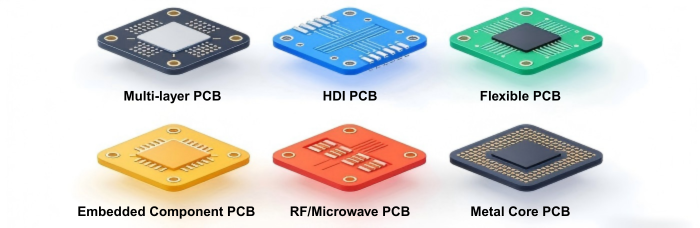
Multilayer PCBs: Multilayer PCBs contain two or more layers of circuitry and are exempted by the single layer feasibility constraint present in single layer PCBs.
High-Density Interconnect (HDI) PCBs: It uses smaller lines, spaces, microvias and buried vias to address the demands of very small devices and still preserve functionality.
Flexible and Rigid-Flex PCBs: Offer a flexible configuration where the substrate is flexible, such as wearables and aerospace system applications.
Embedded Component PCBs: Components are placed on the layers, eliminating the use of discrete components and making it easy to miniaturize.
RF/Microwave PCBs: These PCBs are designed to be used in areas that demand high-frequency signal preservation and minimum losses.
Metal core PCBs (MCPCBs): Contain metal cores, typically made of aluminum, to conduct the heat away, suitable with LED lighting and power supplies.
High-Temperature PCBs: Designed to work under high temperature, important to automobile and industry.
Hybrid PCBs: Assemblies of different materials and substrates to fulfill specific needs of application are seen to be flexible and can be utilized in a wide range of industries.
Applications:
High-end PCBs are used in high-performance fields including aerospace, military technology, telecommunications and medical devices. Their capability to work with high speed data, better EMC and thermal control plays a vital role in these areas where accuracy and dependability are of key importance.
Differences Between Advanced and Standard PCBs
Design Principles:
Advanced PCBs: Entail an in-depth design that incorporates signal integrity, EMC and power integrity. To ensure stability of signals, these boards employ advanced routing technologies such as differential pair routing and length matching.
Standard PCBs: These are mainly concerned with simple functional implementations that do not have any significant requirements on signal integrity and EMC.
Material Selection and Manufacturing:
Substrates and Copper Foil: Advanced PCBs include high-quality materials such as FR-4, Rogers and PTFE as the dielectric material, whereas standard PCBs tend to be made using low-cost materials such as FR-2 or FR-3. Higher current loads can also be carried by advanced boards with heavier copper foils.
Manufacturing Processes: Advanced PCBs have strict manufacturing procedures that involve achieving very good control over impedance, special surface finishes such as ENIG (Electroless Nickel Immersion Gold) and blind/buried vias are used to provide complex interconnections. By comparison, HASL (Hot Air Solder Leveling) is commonly employed to make standard PCBs.
Performance Attributes:
Signal Speed and Integrity: Advanced PCBs have a better signal speed and lower loss, and they are used in the application that requires rapid and correct transmission of data. Conversely, typical PCBs are designed to be used in lower signal requirements.
Thermal and Electromagnetic Performance: Advanced PCBs have enhanced thermal management solutions and enhanced EMC which allow them to operate in high temperature conditions and minimize electromagnetic interference. The common PCBs do not feature high requirements in these aspects.

To conclude, the development of customized and advanced type of printed circuit boards out of the ordinary ones highlights its importance subjects to the speedy-paced innovation in technology and a variety of requirements within different sectors. The simplicity and affordability of standard PCBs keep their usage in traditional applications relevant, but the increasing complexity and performance requirements of modern electronics are the factors that provoke the tendency towards advanced PCBs. These high-technology boards are multi-layered boards with materials of high performance and are needed in industries that demand high degree of precision like in aerospace, military, telecommunications, and medical equipment. The engineers and designers need to understand the subtle differences between these types of PCBs in order to get the appropriate solution that suits their needs with regards to their application requirements.
PCBCart is a trusted partner in this endeavor and not only offers standard but also innovative PCB solutions to satisfy the complex demands of the current hi-tech world. With years of excellence in PCB manufacturing experience, PCBCart is a trusted partner that delivers unmatched levels of excellence and innovation in its manufacturing process. Its experience in complex PCB manufacturing and handling high-tech materials makes sure that clients get the best PCB that can satisfy the highest demands of efficiency and performance. Whether you need PCB prototyping or full-scale PCB assembly services, PCBCart has the capability to fulfill different project demands. We invite you to quote for a PCB project and experience what different engineers and designers have already experienced.
Request for Advanced PCB Assembly & Manufacturing Quote
Helpful Resources
• How to Select Material for Your PCBs from Cost and Reliability Considerations
• Applications and Types of PCBs for Military and Defense Industry
• Key Elements Affecting PCB Manufacturability
• PCB Thermal Design Considerations
• The Most Comprehensive Guidelines for Surface Finish Selection
• Flexible and Flex-Rigid Printed Circuit Board Applications


