



On a fast-turn prototype, the reflow oven is rarely what makes you miss a deadline. Most delays happen before the first paste deposit, in BOM questions and incomplete component kits. More time is lost after assembly, when soldering defects get debugged as if they were design faults. The fastest route to a verified board is a build-ready bill of materials (BOM), a kitting plan agreed at the quote stage, and a first build soldered well enough that every failure you find on the bench is a real design finding.
Schedule pressure on hardware teams tends to peak at the same moment. Layout is done, firmware is waiting, and a design review or customer demo is already on the calendar. This guide explains where prototype PCB assembly time actually goes, why component kitting and soldering quality determine how quickly you can verify a design, and what to send your assembler so the build can start as soon as the quote is accepted.
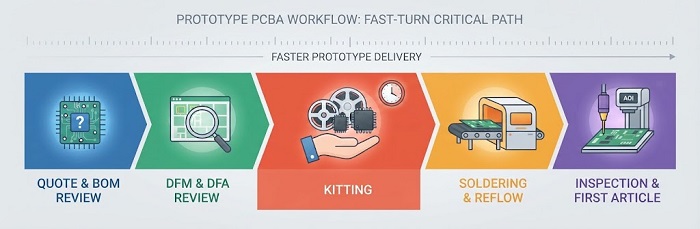
Where Does the Time Go in a Fast-Turn Prototype Build?
Most of the elapsed time in a prototype build is spent waiting for information, not running machines. Placing and reflowing a handful of boards is quick. Waiting two days for an answer about a missing part number is not. The table below maps each stage to what usually stalls it and what you, as the design engineer, can control.
| Stage | What happens | What usually stalls it | What you control |
|---|---|---|---|
| Quote and BOM review | The assembler checks every line for availability, package and ambiguity | Missing part numbers, generic descriptions ("10k 0402"), mismatched reference designators | Submit a complete BOM with a revision ID and placement data |
| DFM/DFA review | Design files are checked for manufacturing and assembly issues | Open questions waiting for a reply | Name one engineer who can answer questions the same day |
| Kitting | Every part for every board is collected and verified before the line starts | One long-lead or unclear part holds up the entire kit | Approved alternates, consigned critical parts, early sourcing decisions |
| Line setup | Machine programs, paste deposition and feeders are prepared for a new board | Late BOM edits that force the setup to be redone | Freeze the BOM revision before kitting starts |
| Soldering and reflow | Paste printing, placement, reflow and any through-hole work | Profile issues on dense or thermally unbalanced boards | Flag BGAs, QFNs, large copper pours and heat-sensitive parts up front |
| Inspection and first article | SPI and AOI, X-ray for hidden joints, first-article check | Defects found here mean rework before shipment | Clear polarity marks and an assembly drawing |
The pattern is consistent. The stages you influence most are the ones that decide whether a fast-turn job is actually fast.
Why Is Component Kitting the Critical Path in Low-Volume Prototype PCBA?
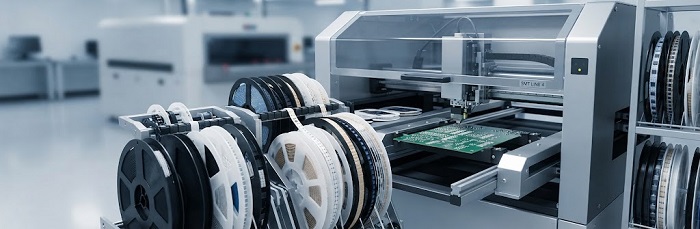
Kitting is the critical path because a line cannot start a board until its kit is complete. A few prototype boards may take only hours to place, but if one regulator or connector is missing, the entire build waits. Low-volume work makes this worse. There is no production buffer, so a single unresolved line item delays every board in the order.
What Makes a Kit Fail?
• Ambiguous BOM lines. A description without a manufacturer part number (MPN) forces the assembler to ask, and work stops until you answer.
• Single-source parts with no alternates. If the exact MPN is unavailable and the BOM offers no guidance, nothing can be substituted, and nothing should be substituted without your sign-off.
• Customer-supplied parts that arrive late or short. Consigned parts that arrive after everything else, or without enough extra length for feeder setup, hold up the build.
• Revision drift. A BOM edited after kitting begins can invalidate parts that have already been pulled.
How Should You Split Sourcing Between Your Team and the Assembler?
For most prototypes, a hybrid approach is fastest. Let the assembler buy commodity passives and standard ICs through authorized distribution. Consign only the parts that are custom, already on your shelf, or so constrained that you secured them yourself.
PCBCart's component sourcing service buys from authorized distributors such as Digi-Key, Mouser, Arrow and Avnet by default and makes no substitutions without customer approval. That policy matters more for verification than for cost. A silently substituted part means your test results describe a board you did not design.
If you plan to supply some or all of the parts, PCBCart offers consigned or partially consigned assembly and accepts SMT parts on reels, tubes, trays, partial reels, cut tape and in bulk. Cut tape is convenient for prototypes, but ship strips long enough for feeder loading, and flag any moisture-sensitive packages so they can be handled correctly before reflow.
Kitting rule of thumb: Decide at the quote stage, not after payment, what happens to every part that is long-lead, single-source or consigned. Each undecided line is a potential stop on the critical path.
How Does Soldering Speed Affect How Fast You Can Verify a Board?
Soldering speed matters less than soldering certainty. The purpose of prototype assembly is to produce a board whose failures are design failures. A bridged QFN, an open BGA ball or a tombstoned 0201 costs more than a rework cycle. It costs the hours spent assuming the schematic is wrong, and it casts doubt on every other measurement taken on that board.
Hand assembly still has a place for simple boards and last-minute changes. For fine-pitch and bottom-terminated packages, however, a controlled machine line is usually the faster path to a design you can trust. These are the process points that make the difference:
• Paste deposition. Consistent paste volume is the foundation of repeatable joints. 3D solder paste inspection (SPI) checks the printed paste before placement, so paste problems are caught before they turn into solder defects. PCBCart applies 100% SPI in its BGA assembly printing process.
• Reflow profiling. A board with heavy copper planes next to small passives needs a profile that heats both properly. In PCBCart's BGA process, reflow runs in a 12-zone nitrogen oven, and the temperature profile is measured at the BGA solder joint positions.
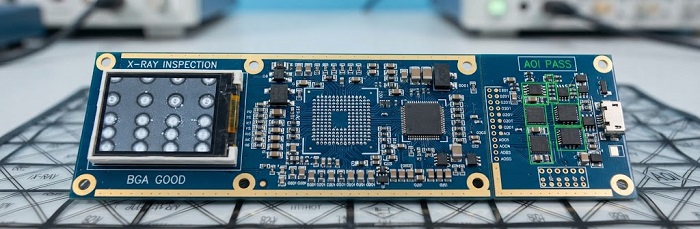
• Hidden-joint inspection. BGA, QFN and LGA joints cannot be judged by eye, which is why AOI and X-ray inspection are used together. PCBCart's BGA assembly process includes 100% X-ray inspection, plus baking and vacuum packaging for moisture-sensitive parts.
• Mixed technology. Through-hole connectors and SMT parts on the same board are routine. Call out press-fit or heat-sensitive through-hole parts early so the process is planned rather than improvised.
The fastest overall schedule comes from one well-controlled assembly pass, not two quick passes with rework in between.
How Do You Verify Prototype Board Functionality Quickly After Assembly?
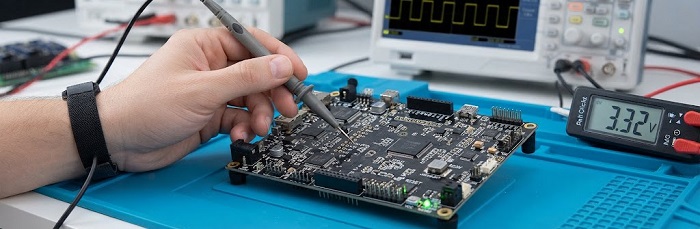
Fast verification starts before the boards ship. Two decisions made when you place the order shorten bring-up considerably: how you split the build quantity, and what inspection evidence comes back with the boards.
Plan the Build for Staged Bring-Up
Instead of ordering identical boards, many teams split a small prototype run by purpose. Mark do-not-populate (DNP) variants clearly in the BOM so the assembler can build each one without guesswork:
• A power-only board with regulators, protection and sequencing populated, so you can verify the supply rails without risking expensive ICs.
• Fully populated bring-up boards for the hardware team.
• Firmware boards shipped directly to software engineers so they are not waiting on hardware debug.
• A reserve board kept untouched as a known-good reference or for destructive testing.
Use First-Article Inspection as an Early Warning
PCBCart offers free first-article inspection (FAI) on assembly orders, using flying probe, AOI and X-ray. You can approve the first article from emailed images for a basic check, or have the board shipped to your own lab for a closer look. When the deadline is tight, image approval is a quick way to catch a polarity or orientation error in your own assembly drawing before the rest of the build is committed.
Follow a Fixed Bring-Up Sequence
Running tests in a consistent order keeps a fault in one subsystem from damaging another:
| # | Check | Why it comes at this point |
|---|---|---|
| 1 | Visual and microscope inspection | Confirms orientation and catches obvious defects before power is applied |
| 2 | Unpowered rail-to-ground resistance | Detects shorts that would damage parts at power-up |
| 3 | Current-limited first power-up | Limits damage if a rail or component is faulty |
| 4 | Rail voltages and power sequencing | Verifies the power tree before any logic is trusted |
| 5 | Clocks and reset | Nothing downstream is meaningful without stable clocks and a clean reset |
| 6 | Programming and debug interface | Confirms the board can be flashed; PCBCart also offers IC programming |
| 7 | Peripheral and interface tests | Exercises each subsystem in isolation |
| 8 | Full functional test | Validates the board against its specification |
Test points, a debug header and current-measurement access designed into the layout pay off here. They turn every check above into a quick probe rather than a rework job.
What Should a Build-Ready BOM Contain?
A build-ready BOM lets the assembler quote, source and kit your parts without asking a single question. Every missing field in the table below is a likely email, and every email takes time off your schedule.
| BOM field | Why it speeds up a prototype build |
|---|---|
| Reference designators | Must match the silkscreen and placement file exactly; mismatches stop kitting and machine programming |
| Manufacturer and MPN | Removes ambiguity so the assembler buys exactly what you specified |
| Quantity per board | Prevents short kits; the assembler adds the overage, not you |
| Package or footprint | Confirms the part matches the land pattern before it is purchased |
| DNP flags and build variants | Lets power-only and fully populated builds come from one BOM |
| Approved alternates and flexibility | Marks each part as critical, alternate-approved or non-critical, so shortages are resolved in hours rather than days |
| Supplied-by column | Shows which parts you will ship and which the assembler will source |
| BOM revision ID | Ties the kit to one frozen revision of the design |
Send the BOM with your design files, the pick-and-place (centroid) file and an assembly drawing that marks polarity and pin 1. Before you release the files, take care of two things that commonly cause late questions:
• Run a design review. PCBCart provides a free design for manufacturability and assembly (DFM/DFA) review using Valor, so issues surface during quoting rather than after parts have been purchased.
• Check panelization. Small prototype boards usually need to be panelized for machine assembly. PCBCart assembles panels from 50 × 50 mm to 310 × 410 mm and can help panelize a single-board design. Reviewing the panel requirements for fiducials, tooling strips and unit spacing before release keeps this off the critical path.
How Does PCBCart Support Fast-Turn Prototype PCB Assembly?
PCBCart's prototype PCB assembly service covers the steps described above, from parts sourcing and design review to assembly and inspection. In practice, that means:
• Quotes within one to two working days after you submit your design files and BOM.
• Authorized-distributor sourcing by default, no substitutions without your approval, and the option to buy from your preferred suppliers. Component sourcing typically takes around one week, depending on how difficult the parts are to obtain.
• Flexible kitting options, including full turnkey, partial consignment and full consignment, with reels, trays, tubes, cut tape and bulk parts accepted.
• Free DFM/DFA review and free first-article inspection, plus IC programming and custom testing on request.
• High-mix process capability, covering components from 01005 and 0201 through BGA, QFN and WLCSP packages, single- and double-sided SMT, and mixed SMT and through-hole builds.
• No minimum order quantity, with NDAs available for confidential designs.
PCBCart also offers low-volume, high-mix production, so once the design is verified, you can move from prototype to pilot run with the same supplier.
Frequently Asked Questions
Can a Prototype Build Start Before Every Part Has Arrived?
Sometimes. An assembler can build everything except the late parts and fit them afterward, but every part hand-soldered after reflow adds another heating cycle and more handling. For BGAs, QFNs and other bottom-terminated parts, this is rarely worth the risk. If a late part is unavoidable, agree on the approach at the quote stage and limit it to through-hole or easily reworked SMT parts.
Should Prototypes Be Built to IPC Class 2 or Class 3?
Build to the class your production units will use. If the product requires Class 3 workmanship, prototypes assembled to Class 2 can hide joint-related issues that surface later, and your verification data will not reflect production conditions. PCBCart's assembly services meet IPC Class 3 standards.
Does a DFM Review Slow Down a Fast-Turn Job?
Not when it runs during quoting. A review that flags a footprint mismatch or a missing paste opening before parts are bought costs hours. The same issue found on the line costs a rework cycle and possibly a board respin.
Is It Faster to Consign All the Parts Myself?
Usually not. Full consignment puts every shipping delay, short count and packaging problem on your side of the schedule. Consign only the parts you alone can obtain, and let the assembler source the rest in parallel.
What Is the Most Effective Way to Shorten a Prototype Schedule?
Submit a complete BOM with approved alternates, and name an engineering contact on day one. Nearly every delay described in this article traces back to an unanswered question about a part.
Ready to Start Your Build?
If your layout is complete and your deadline is fixed, the fastest next step is to get your BOM in front of an assembler. Submit your BOM along with your design files and placement data, and mark any parts you plan to consign. PCBCart will return pricing and any DFM/DFA findings so your prototype can move straight into kitting.
Helpful Resources
• How to Create a BOM (Bill of Materials)
• Full Turnkey vs. Partial Turnkey PCB Assembly: Which Is Right for You?
• What Happens to My Lead Time When a Component Goes Out of Stock?


