



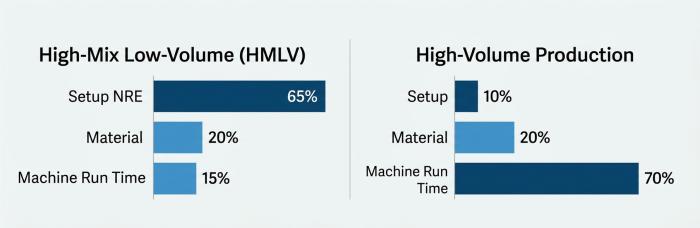
In a high-mix, low-volume build, most of what you pay for and wait on is not the assembly run. Setup work gets spread over very few boards, and lead time is usually set by when the last part arrives, not by machine hours. The two things a buyer controls are how many lots you split an order into and how many different part numbers you put on the BOM.
What counts as high-mix, low-volume?
HMLV describes a production pattern more than a quantity. A shop running HMLV builds many different board designs, often several revisions of each, in small lots that repeat irregularly. There is no single cutoff, and we don't think a fixed number helps. The useful test is whether setup work (loading feeders, preparing the stencil, loading the program, running first-piece checks) is a meaningful share of the total work on your order. If it is, you are buying HMLV, whether the lot is 5 boards or 500.
That is why a 300-piece order with 180 unique part numbers behaves differently from a 3,000-piece order with 40. The first spends its effort on kitting and changeover. The second spends it on run time. Industrial control boards, test fixtures, lab instrumentation and semiconductor test equipment usually fall into the first group, which is the work PCBCart is set up for.
Prototype and pilot builds sit at the small end of the same spectrum. If you are still iterating the design, our prototype assembly page covers a different set of trade-offs, mostly about speed of feedback.
Where does the money go in a low-volume build?
Most quotes break down into a few items. We won't give numbers here, because they depend on your design, but the cost structure is consistent across jobs.
| Cost item | What drives it | What you can change |
|---|---|---|
| NRE and engineering review | DFM review, BOM and CPL checking, resolving questions on polarity, footprints and alternates | Send a clean BOM with manufacturer part numbers, a CPL that matches the Gerber, and an assembly drawing with polarity marked |
| Stencil | One stencil per board side and per design; step or special apertures add complexity | Reuse the same stencil across lots of the same revision; avoid revision churn on the paste layer |
| Programming and line setup | Pick-and-place program, feeder allocation, reflow profile selection | Keep the same design files between lots so existing programs can be reused |
| Changeover | Number of distinct designs, feeders to swap, parts that need special handling | Combine lots of the same design into one run |
| First article | Checking the first assembled board before releasing the rest | Give clear acceptance criteria up front |
| Fixtures and test | Pallets for selective or wave soldering, test jigs | Decide early whether you need them; they are one-off costs per design |
| Material handling | Cut tape vs. full reel, small-lot minimums, part-level traceability | Standardize on package types that are easy to source |
A few of these deserve more detail.
The stencil is a fixed cost per design and per side, so it hits a 20-piece order exactly as hard as a 2,000-piece one. If you are comparing quotes, check whether the stencil is quoted separately or buried in the unit price, because that changes how the numbers look at different quantities. Our laser stencil page covers what we need from you for that part.
Programming and changeover are the part buyers tend to underestimate. A pick-and-place program has to be built or verified for every design, and the feeder setup has to match the BOM. Do that for five designs in a week and you pay for five setups. If two of them are variants of the same board, the cost you see on the quote is mostly a function of how many distinct setups the shop has to do, not how many boards come out.
First-article checking is where we spend time on the first board of a lot. We look at 3D SPI and AOI results, and use offline X-ray when there are BGAs or other hidden joints, before the rest of the lot is released. On a small lot it feels like a lot of effort for few boards, but it is much cheaper than finding a polarity or footprint error after all of them are built. This is rarely worth skipping.
How does BOM complexity drive setup?
Quantity of boards matters less than quantity of unique line items. Each unique part number needs a feeder slot, a verified footprint and a place in the kit. A BOM with 150 lines and a handful of boards per lot is a very different job from a BOM with 40 lines and the same quantity.
Three BOM patterns raise setup effort more than others.
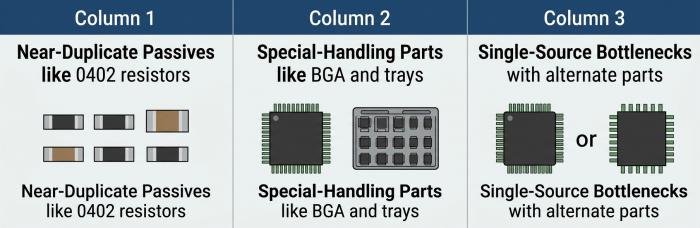
The first is a large number of near-duplicate values. If your design has 0402 resistors at six slightly different values that could be two, you are paying for four extra feeders, four extra kit positions and four extra chances for a mix-up. Engineers pick these values for good electrical reasons sometimes, but often it is habit carried over from an earlier design.
The second is packages that need special handling: fine-pitch parts, BGAs, moisture-sensitive devices, odd-form connectors, and anything that arrives in trays or tubes rather than on reels. These can need different feeder hardware or manual steps, and they slow down verification.
The third is a BOM with no approved alternates. When a single-source part is short, the whole job waits. Listing acceptable alternates up front, with manufacturer part numbers, turns a stalled order into a quick substitution decision.
If you want to see how we think about the material side, our components sourcing page describes the process, and it explains why a clean BOM matters so much to us.
Before you send files, a short check helps:
Every line has a manufacturer part number, not just a description or a value.
Reference designators in the BOM, CPL and assembly drawing agree with each other.
Do-not-populate parts are marked clearly, not just left off.
Alternates are listed for parts you know are tight on supply.
Parts that need special handling (moisture-sensitive, hand-placed, fixture-supported) are flagged.
What really sets lead time?
In most low-volume jobs we see, the machine time is the smallest part of the schedule. A line can place a small lot of boards quickly. What takes time is getting every component on the BOM into the building, in a form we can use, with the right part numbers.
The factors that usually control lead time, roughly in the order they cause trouble:
One or two long-lead or allocated parts. A single line item can hold up an entire lot, however simple the rest of the BOM is.
Minimum order quantities and package sizes. A part sold only in full reels or in large multiples may need a different sourcing route, or a different approval step on your side.
Questions that come back to you. A missing polarity mark or an unclear footprint note stops kitting until someone answers. This is the one delay we can both avoid.
Part substitutions that need approval. If a part is unavailable and an alternate has to be approved, the clock runs while that decision is made.
Fixtures or special tooling, if the design needs them.
Board fabrication, if you are buying bare boards from us too, and the board has special stackup or process requirements.
We don't quote lead times in an article like this, because they depend on your BOM and the supply situation at the time. What we can say is that if you want a shorter schedule, the most effective thing you can do is clear material questions early, not ask for faster machine time. Getting the BOM reviewed and the open questions closed before the order is placed tends to shorten the real schedule more than anything on the shop floor.
How can you order smarter?
There are three habits that make HMLV orders cheaper and calmer, and none of them need special tools.
Merge lots where the design allows it
If you know you will need the same board three times this quarter, ordering them as one lot with staged delivery usually costs less in setup than three separate orders. You pay for the stencil, program and first-article checks once. The trade-off is that you commit to material and cash earlier, and that is a real cost. We usually suggest merging when the design is stable and the demand is fairly certain, and not merging when a revision is likely before the second lot.
Standardize parts across variants
If you have a family of boards, such as a base version and two option versions, check whether they can share the same passives, connectors and ICs wherever the design allows. Fewer unique parts means fewer feeder positions, a shorter kit list, less material waiting for a lot that never arrives, and a better chance that a shortage on one line item doesn't stop everything. This is often worth doing at the design stage, because it is much harder to change after release.
Use panelization sensibly
Putting several boards on one panel changes how efficiently they go through printing, placement and reflow, and it affects handling and depaneling. Panel size, rails, fiducials and break-away method all interact with the assembly line, so confirm panel dimensions and layout with our engineering team before you finalize them. Don't assume a panel that works at one shop will work at another. If you are assembling several different small boards, a combined panel of different designs is sometimes possible, but it needs review first.
None of these habits are free. Merging lots ties up cash and inventory. Standardizing parts can mean accepting a slightly less optimal component. Panelization constrains your outline. Whether they are worth it is a judgment about your volume and design stability, not a rule.
When is an HMLV partner a better fit than a volume CM?
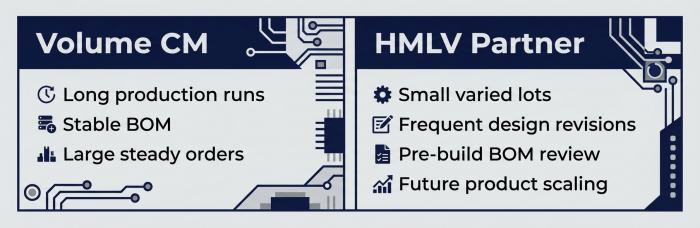
A volume contract manufacturer is built around long runs of the same board. Its economics improve when the line stays on one design for a long time, and its processes tend to assume stable BOMs and large, regular orders. That is a good fit if you have a mature product with steady demand.
An HMLV partner is a better fit when your orders are small, varied or irregular. A few signs:
You carry many board designs, and each one is ordered in small lots.
Your designs change often enough that revision control and engineering questions are a normal part of every order.
You need the shop to review the BOM and files before building, not just execute them.
You expect to scale one product up later but are not there yet.
It is worth being honest about the reverse case. If a product has settled into steady, high-quantity demand, a shop set up for volume work will probably serve you better on unit cost, and you should look at our high-volume assembly page or a volume CM.
For smaller, mixed orders, our low-volume assembly service is built for this kind of work. We run Smart MES to track material and build records, and our line uses a MYCRONIC jet printer, 3D SPI and AOI, offline X-ray and a JTR-1200D-N reflow oven. We work from your Gerber files and BOM, and we don't offer schematic design.
FAQ
Does a bigger order always lower the unit price in HMLV work? Not always. Quantity helps spread setup cost, but if the extra boards bring more unique parts, more variants or a longer material wait, the benefit shrinks. Look at the number of distinct setups in the order before you look at the total board count.
Should I buy extra parts to protect against shortages? It depends on the part. For cheap passives with a long production history, small overage is routine and usually fine. For expensive, single-source ICs, buying extra is a financial decision you should make deliberately. Ask us which lines are at risk before you decide.
Is it better to send a consigned kit or have you source the parts? Both work. Consignment gives you control over the parts but moves the burden of completeness and labeling to you, and a missing or mislabeled part will stop the job. Sourcing through us can reduce that risk, at the cost of passing through the supply situation. Tell us at quote stage which you prefer, and we'll flag anything that looks risky.
What files make a quote faster and more accurate? Gerber files, a BOM with manufacturer part numbers, a CPL (pick-and-place file) and an assembly drawing with polarity and special instructions. If anything is missing or contradicts something else, expect questions before we can quote.
When should I change the design to reduce setup cost? Early, ideally before release. Consolidating passive values, reducing the number of package types and avoiding single-source parts are all easier at the schematic stage. After the design is released, the same changes usually need re-validation and may not be worth the effort.
Get a PCB Assembly Quote
Helpful Resources
• Understanding NRE Fees in HMLV PCBA: What's Included and What Isn't
• RFQ Preparation Checklist: What Information Your EMS Partner Needs for an Accurate HMLV Quote
• How to Create a BOM (Bill of Materials)
• Why MOQ Minimums Are Killing Your HMLV Program — and How to Fix It Before RFQ
• Turnkey vs. Consigned PCB Assembly: Which Saves More Time and Cost?
• Panelization and Array Design Guidelines for Efficient High-Mix SMT Assembly


