



Semiconductor test equipment companies eventually face the same capital allocation question: build internal PCBA capacity for ATE interface boards, or route that work to a contract manufacturer built for high-mix, low-volume (HMLV) work. Neither answer is universally correct. The right choice depends on production profile, engineering bandwidth, and how much variability the board portfolio carries year over year. This article lays out a structured way to evaluate the decision rather than a single recommendation.
Why the Build-vs-Outsource Decision Differs for ATE Interface Boards
ATE interface boards — probe cards, load boards, DIB (device interface boards), burn-in boards — differ from typical industrial PCBA in several respects that materially change the build-versus-buy calculation:
Low unit volumes, high board diversity. A single ATE program might need 5–50 boards of a given design, followed by a design revision before the next test insertion.
High component and layout complexity. BGA/QFN devices, controlled impedance routing, and fine-pitch connectors are common, which raises the skill floor for SMT setup, SPI/AOI programming, and X-ray inspection.
Frequent engineering changes. Test program updates and DUT (device under test) revisions can trigger board rework mid-program.
Tight coupling to test engineering. Assembly defects surface as test yield problems, so traceability back to a specific placement or reflow run matters more than in typical production PCBA.
These characteristics mean the cost comparison cannot be reduced to a simple per-board price comparison between in-house and outsourced production. It must account for engineering overhead, equipment utilization, and the speed at which a line can pivot between board revisions.
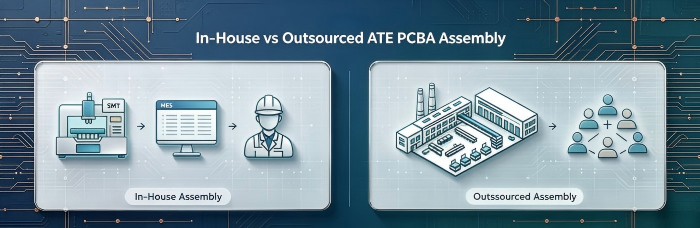
Cost Structure Comparison Framework
Capital Equipment Investment
In-house capacity for ATE-grade boards typically requires:
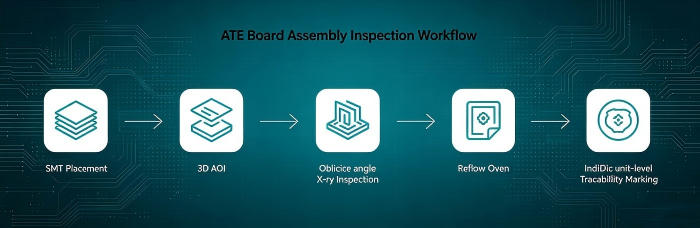
SMT placement equipment capable of fine-pitch and BGA/QFN work
3D SPI (solder paste inspection) and 3D AOI (automated optical inspection) for closed-loop process control — not just AOI alone, since paste volume defects are a leading cause of BGA voiding
X-ray inspection, ideally oblique-angle capable, for BGA/QFN void and solder joint verification
A reflow oven with a profile-verified thermal window for mixed BGA/fine-pitch assemblies
MES or equivalent traceability tooling with unit-level (UID) tracking, since test yield investigations require tracing a failure back to a specific placement and reflow lot
This is a meaningful capital outlay relative to the volume it will process. For a company running a handful of ATE programs, this equipment set can sit underutilized for large stretches of the year between board revisions.
Engineering Team Configuration
Beyond capital equipment, in-house assembly requires a standing team: process engineers to own SPI/AOI programming and reflow profiling, an SMT/rework technician team competent on fine-pitch and BGA rework, a quality function to manage inspection records and traceability, and someone to manage component sourcing — sourcing is its own burden for ATE boards, since many use specialty connectors, precision resistors, or lower-volume analog components with longer lead times.
Capacity Utilization Dynamics
This is the dimension along which the cost framework most often favors outsourcing for ATE-focused organizations. HMLV production is, by definition, characterized by frequent changeovers and small lot sizes. An in-house line sized for peak-program demand will remain idle between programs; a line sized for average demand will bottleneck when multiple programs require boards simultaneously. An HMLV-focused external partner amortizes the same equipment and engineering overhead across many customers' variable demand — a structural efficiency that is difficult for a single company to replicate internally unless its own board volume is large and steady enough to keep the line consistently loaded.
Organizational Fit: In-House Build vs. Outsourced Assembly
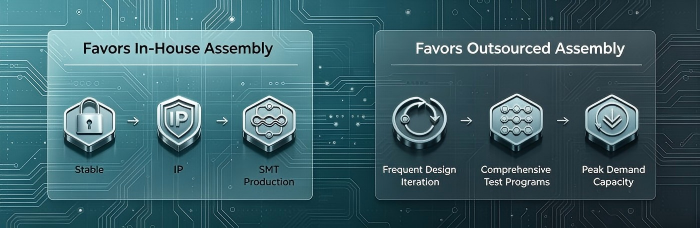
Rather than volume thresholds — which vary by board complexity and internal cost structure — the following organizational profiles describe the characteristics that tend to favor each approach.
Profile Favoring In-House Assembly
Test equipment companies with a narrow, stable set of board designs that see minimal revision churn
Organizations where board assembly is treated as a strategic differentiator tightly coupled to proprietary test IP, and where IP control is a stronger driver than unit cost
Companies with existing SMT capability from adjacent product lines, where ATE board volume can share capacity with other production rather than requiring dedicated investment
Profile Favoring Outsourced Assembly
Companies supporting many concurrent ATE programs with frequent board revisions and small, unpredictable lot sizes
Organizations where internal engineering headcount is better allocated to test program development than to SMT process engineering
Companies whose board designs push fine-pitch, BGA, or high-layer-count complexity beyond what their current internal equipment or expertise reliably supports
Teams that need fast pivot between board configurations without carrying idle capital equipment
Core Capability Criteria for Evaluating an Outsourcing Partner
Where outsourcing is the selected direction, the evaluation should extend beyond price quotations. The following capability areas warrant direct verification:
Process Control for Complex Packages
Evaluate specifically how a candidate partner controls BGA/QFN voiding and solder joint quality. Closed-loop 3D SPI and 3D AOI — rather than 2D AOI alone — indicate a more mature process control loop, since paste deposition data can be fed back to correct placement or printing parameters before defects propagate downstream.
Inspection Depth for BGA/QFN Packages
For BGA and QFN devices common on ATE boards, confirm that the partner maintains X-ray inspection with oblique-angle capability, which permits inspection of solder joints concealed beneath the package body. Standard top-down X-ray can miss voiding on the far side of a ball grid.
Traceability Architecture
Given how tightly ATE assembly defects couple to test yield, verify that the partner's MES supports unit-level identification (UID) and laser marking, enabling a specific board to be traced back to its placement, paste, and reflow lot in the event a field or test failure investigation is required.
Selective Soldering and Mixed-Technology Handling
Many ATE boards combine SMT and through-hole connectors, particularly high-density interconnects and precision headers. Automated selective wave soldering with nitrogen protection reduces defect rate and thermal stress risk relative to manual hand soldering on these mixed-technology assemblies.
Warpage Control for Fine-Pitch Assembly
Evaluate how the partner manages board warpage during reflow, particularly for larger or thinner ATE board form factors. Synthetic stone fixtures are one established approach for maintaining flatness through the thermal cycle and reducing BGA coplanarity defects.
Operational Fit for HMLV Production
Beyond technical capability, confirm that the partner's engineering and quality processes are genuinely structured around frequent changeovers and small lot sizes, rather than adapted from a high-volume production model. This distinction is reflected in how quickly a new board revision can move through NPI and into production.
Hybrid Model Feasibility: Combining In-House and Outsourced Assembly
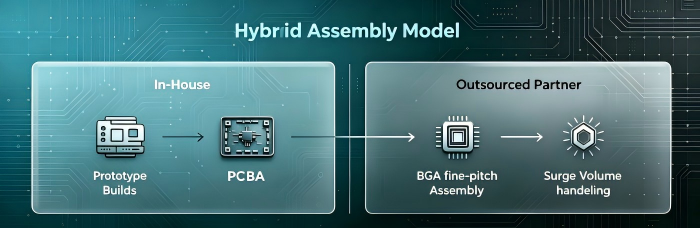
For many organizations, the realistic answer is not a binary choice. A hybrid model — retaining core, IP-sensitive assembly steps in-house while outsourcing high-precision or high-complexity board builds — merits evaluation under the following conditions:
Only a subset of the board portfolio requires advanced BGA/QFN or fine-pitch capability, while simpler boards can run on existing internal lines
Prototype or early-NPI builds happen in-house for engineering iteration speed, while volume production of stable designs moves to an external partner
Internal capacity handles baseline demand while an external partner absorbs surge or overflow volume during peak program cycles
The trade-off inherent to a hybrid model is added coordination overhead: two sets of documentation, two quality systems to reconcile, and a defined rule governing which boards are routed where. This approach performs best when the split is defined by explicit technical criteria — package type, layer count, changeover frequency — rather than determined on a case-by-case basis.
Request an Outsourcing Feasibility Assessment
Working through this framework internally is a useful exercise, but the variables specific to a given program — board complexity, current lot sizes, and revision frequency — ultimately determine which side of the decision applies. PCBCart's engineering team evaluates ATE board portfolios against the criteria outlined above: package complexity, inspection requirements, traceability needs, and HMLV production fit.
Submit your board specs or Gerber/BOM package for a feasibility review, and PCBCart will provide a written assessment covering:
Whether your board complexity fits a standard HMLV outsourcing model or requires a hybrid approach
Process capability match (BGA/QFN handling, X-ray inspection depth, traceability requirements)
Where a phased or hybrid transition — starting with a pilot lot before full production handoff — makes sense
Submit your project details to begin, or contact the engineering team directly with questions specific to a given board program.
Helpful Resources
· Top HMLV EMS Providers: What to Consider When Choosing
· True Cost Breakdown of HMLV PCBA Builds
· 10 Questions to Ask Any EMS Partner Before Signing
· Managing Obsolescence Risk for Long-Lifecycle Semiconductor Test Equipment PCBA


