



Industrial control systems, semiconductor test platforms, and medical instrumentation are frequently designed for a 10–15 year service life. The silicon inside them is not. Mainstream MCUs, FPGAs, and specialty analog parts typically see active production windows of 5–8 years before a manufacturer issues a Product Change Notice (PCN) or End-of-Life (EOL) notification. That mismatch is structural, not accidental — it's a direct consequence of semiconductor process node turnover outpacing industrial equipment refresh cycles.
For a program owner, this means obsolescence isn't a "might happen" risk. It's a scheduling problem. Components are rarely brand-new silicon at the point of design-in — a part may already be one or two years into its production life when it's first placed on a BOM. Combined with a 5–8 year active-production window, that means at least one critical component on a 10–15 year program will almost certainly hit EOL well before the product itself reaches end of sale, often earlier in the program than teams expect. The question is not whether this happens, but whether the response is planned or reactive.
The Core Mismatch, in Practical Terms
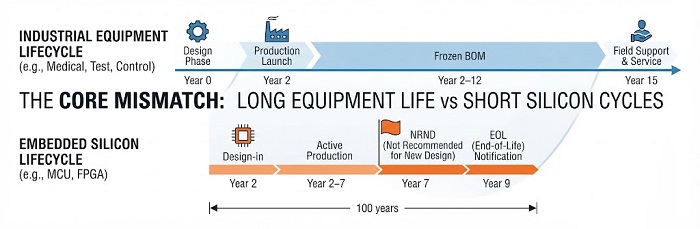
Product side: capital equipment, test fixtures, and Class II-adjacent medical devices are typically re-qualified only every several years due to validation cost, so BOMs stay frozen for long stretches.
Component side: MCU/FPGA vendors optimize for consumer and mobile volume, where node transitions happen every 2–3 years. Once a part falls out of a fab's priority allocation, EOL follows.
Net effect: a design frozen at launch is often, within a few years, built on process generations the manufacturer has already stopped supporting.
An EMS partner's job in this environment isn't just "build what's on the BOM" — it's flagging where the BOM is aging out from underneath the customer, early enough that there's still a choice of response.
Four Contingency Strategies: Cost-Benefit Comparison
There's no universally "correct" answer here; the right strategy depends on remaining program life, unit volume, and how deeply the part is embedded in system behavior.
1. Last-Time-Buy (LTB)
Buy a multi-year inventory of the EOL part before the manufacturer's final order date.
Pros: zero requalification, zero design risk, fastest to execute.
Cons: large upfront capital tied up in inventory; storage and traceability burden; still finite — it delays the problem rather than solving it.
Best fit: parts with roughly 2–4 years of remaining program life, or parts too deeply embedded (firmware-coupled, analog-critical) to replace easily in that window.
2. Alternate/Second-Source Part Qualification
Identify a form-fit-function equivalent from another vendor or product line and validate it into production.
Pros: solves the problem structurally rather than deferring it; often cheaper than LTB over a full product lifetime.
Cons: requires engineering time for equivalence testing (see process below); may require firmware register-map changes if the alternate isn't pin-and-register identical.
Best fit: passive components, memory, standard logic, and increasingly MCUs where a close architectural equivalent exists.
3. Design Re-spin
Redesign the affected circuit block — or the full board — around a currently available part family.
Pros: resets the obsolescence clock; an opportunity to address other known EOL risks in the same pass.
Cons: highest cost and longest timeline; for regulated devices, may trigger a new validation or verification cycle.
Best fit: when two or more critical parts on the same board are approaching EOL simultaneously, or when the current part has no viable alternate.
4. Multi-Sourcing at Design Time
Architect the BOM from the outset with two or more qualified sources per critical part, ideally decided at the schematic/layout stage before first production.
Pros: the lowest long-run cost strategy; avoids crisis-mode requalification entirely.
Cons: only effective if decided early — it isn't retrofittable onto a board already in the field without a re-spin.
Best fit: any new program expected to run 8+ years, especially where the customer controls the design and EMS input happens pre-layout.
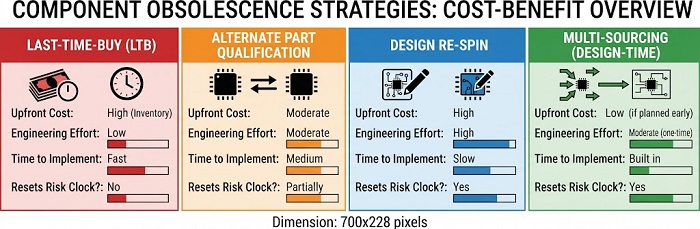
| Strategy | Upfront Cost | Engineering Effort | Time to Implement | Resets Risk Clock? |
|---|---|---|---|---|
| Last-Time-Buy | High (inventory) | Low | Fast | No |
| Alternate Part Qualification | Moderate | Moderate | Medium | Partially |
| Design Re-spin | High | High | Slow | Yes |
| Multi-Sourcing (design-time) | Low (if planned early) | Moderate, one-time | Built in from the start | Yes |
EMS-Level Early Warning: Catching Risk Before It's a Crisis
The strategies above only work if there's enough lead time to choose deliberately. That lead time comes from monitoring the BOM before a shortage becomes a line-down event:
BOM risk scoring: cross-referencing part numbers against vendor lifecycle status (Active, NRND — Not Recommended for New Design, EOL) as published by the component manufacturers themselves. NRND flags are the earliest actionable signal, often appearing years before a formal EOL notice.
Single-source flagging: identifying line items with only one approved manufacturer/part number and no drop-in alternate on file.
Lead-time trend monitoring: a sudden jump in quoted lead time — for example, from a stable 12 weeks to 40+ weeks — on a previously routine part is frequently an early proxy for allocation tightening, sometimes appearing before any official EOL notice.
Distributor allocation status: a part moving onto allocation at multiple distributors simultaneously is a stronger signal than a single distributor stockout.
None of this eliminates shortage risk, but it does change the shape of the problem: instead of an 8-week fire drill, it becomes an 18-month planning window — the difference between an unhurried last-time-buy and paying gray-market premiums under pressure.
Alternate Part Qualification: The Three-Layer Validation Process
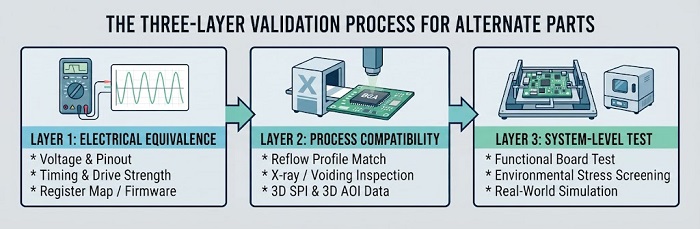
Once a risk signal is caught early, qualifying an alternate part is the strategy most teams reach for first — but it isn't a spreadsheet exercise. A part that looks equivalent on a datasheet can behave differently once it's actually assembled onto a board. A defensible qualification process covers three layers.
Electrical Equivalence
Compare not just the headline parameters (voltage, package, pinout) but secondary characteristics: timing margins, drive strength, thermal derating curves, and — for digital parts — register map or instruction set compatibility if firmware reuse is intended.
Process Compatibility
The alternate part must survive the same assembly process without introducing new defect modes. This is where physical inspection data matters:
Reflow profile compatibility is verified against the part's actual thermal mass and moisture sensitivity level, not just the reflow oven's default recipe.
For BGA/QFN packages, X-ray inspection — including oblique-angle imaging — confirms solder joint formation and voiding levels are consistent with the original part's known-good profile. Package size or ball pitch differences between "equivalent" parts are a common source of hidden defects here.
3D SPI and 3D AOI data from the first qualification builds establish whether the alternate introduces any new placement or paste-volume sensitivity relative to the incumbent part.
System-Level Test
Board-level functional test under the same test coverage as the original part, plus — where applicable — environmental stress screening consistent with the product's field conditions.
Only once a part clears all three layers should it be added to the BOM as an approved alternate, rather than treated as a one-time substitution.
Medical Devices: A Different Risk Calculus (With a Boundary)
It's worth being explicit here: we do not hold ISO 13485 certification. We are not positioned to make regulatory recertification determinations, and any customer relying on this framework for a regulated medical device should treat the following as a starting logic tree for their own regulatory/quality function — not as guidance from us on FDA or notified-body submission strategy.
That said, the underlying engineering logic is worth stating plainly, because it changes which of the four strategies is realistic:
A component substitution that is electrically and functionally identical, with no change to safety- or performance-critical parameters, is more likely to be treated as a minor change under most regulatory quality systems.
A substitution affecting timing, power consumption, or any parameter tied to a validated safety or performance claim is more likely to trigger a design-change assessment, and potentially re-verification or re-validation.
The determination itself belongs to the device manufacturer's regulatory/quality function. An EMS partner's role is to supply complete, accurate equivalence data — the three-layer validation above — so that determination can be made on real evidence rather than a datasheet skim.
This is precisely why last-time-buy is often the pragmatic first move for regulated devices facing a mid-program EOL event: it buys time to make a substitution decision deliberately, rather than under shortage pressure.
Where to Start
Most shortage risk doesn't originate on the day an EOL notice arrives — it's visible the moment an NRND flag appears or lead times start behaving abnormally. The difference is whether anyone is looking at the BOM at that point.
Rather than waiting for a critical part's lead time to jump from 12 weeks to 40+, it's worth running a baseline check now: send us your BOM and we'll help identify which components are already flagged NRND/EOL, which are single-sourced, and which are showing early lead-time anomalies.
This isn't a sales pitch disguised as a screening — if the check comes back low-risk, we'll tell you that directly. Where risk is identified, we can walk through which of the four strategies above — alternate qualification, last-time-buy, or otherwise — fits each specific part.
Ressources utiles
• How PCBCart Delivers High-Quality PCBA Services for Industrial Sector
• Why Precision Matters: Choosing PCBCart for Medical PCBA Services
• Managing Thermal Reliability in Diagnostic Instrument PCBA
• Common SMT Defects and How to Avoid Them


