



Executive Overview: Warpage as a Critical Failure Mode for ≥8-Layer Medical Multilayer PCBA
High-layer (8L+) multilayer control PCBs form the core of diagnostic analyzers, patient monitoring modules and clinical lab test equipment within life sciences electronics. Lead-free reflow peak temperatures ranging 240°C~250°C trigger irreversible board warpage originating from FR-4 substrate moisture absorption and asymmetric laminate stack-up mismatch, breaking BGA/QFN co-planarity and generating latent field failures including open solder joints, head-in-pillow defects and fixture misalignment during end-product functional testing. Per IPC-6012 Class3 medical-grade specification, maximum allowable board warpage is capped at 0.75% of PCB diagonal dimension, a threshold routinely violated on unprocessed high-layer medical substrates without pre-assembly moisture bake and precision SMT carrier fixturing. This article breaks down root warpage drivers specific to medical multilayer boards and PCBCart’s validated production controls built upon automotive zero-defect process frameworks.
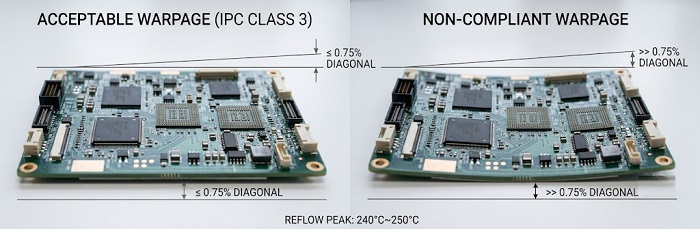
Root-Cause Analysis of High-Layer Medical PCB Warpage Under Reflow Thermal Load
Two dominant root causes drive over-limit bow/twist deformation for ≥8-layer FR-4 medical substrates during SMT reflow, both compounded by the dense BGA array layouts typical for clinical control hardware:
1. Pre-Assembly Moisture Absorption of FR-4 Dielectric
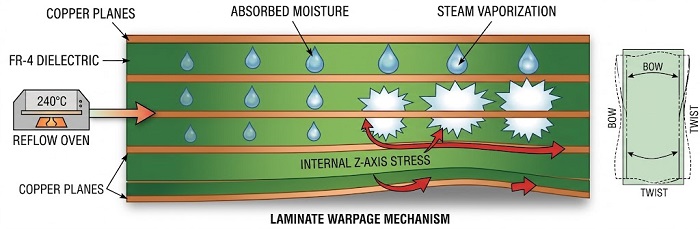
Standard FR-4 laminate absorbs ambient moisture at relative humidity >50% during bare-board transit and warehouse storage; absorbed water vapor instantly vaporizes under 240°C+ peak reflow heat, creating internal z-axis mechanical stress that delaminates prepreg-core interfaces and locks permanent board bow after cooling. High-Tg FR-4 (Tg≥170°C, preferred for multiple reflow cycles in medical builds) still retains 0.2~0.4% ambient moisture content without controlled baking, sufficient to induce >1% diagonal warpage on 120mm×160mm 8-layer medical PCBs. Medical PCBA often undergoes dual-sided SMT + selective wave soldering, exposing boards to two sequential reflow thermal cycles and amplifying moisture-driven deformation risk further.
2. Asymmetric Multilayer Stack-Up & Unbalanced Copper Density
Most custom medical multilayer layouts feature uneven copper pour distribution across opposing layers: ground/power planes occupying 70~90% copper coverage on inner layers paired with sparse signal traces (<30% copper area) on mirrored counterpart layers, creating differential thermal expansion stress during lamination and reflow heating (FR-4 XY CTE:14~17ppm/°C vs copper CTE:17ppm/°C). Asymmetric blind/buried via constructions common on HDI medical high-layer boards further disrupt Z-axis structural balance, leading to diagonal twist warpage post-reflow that directly compromises BGA coplanarity (allowable coplanarity deviation for 0.5mm pitch BGA: ≤0.08mm across component footprint).
PCBCart’s Dual-Pillar Production Controls for Warpage Mitigation & Co-Planarity Preservation
To consistently hold finished medical PCBA warpage below 0.5% (stricter than IPC Class3’s 0.75% upper bound) and maintain precision BGA/QFN co-planarity, our EMS facility enforces two sequential validated process controls executed for all ≥8-layer medical incoming substrates: pre-SMT vacuum moisture baking and custom-engineered Durostone SMT pallet (reflow carrier) fixturing across full SMT production flow (print→pick&place→reflow).

Pillar 1: Precision Vacuum Pre-Bake: 4–8 Hours Controlled Dehydration Prior to SMT Launch
All incoming high-layer medical PCBs are routed to climate-controlled vacuum bake chambers before entry into SMT production lines, following application-dependent bake duration rules aligned with FR-4 material grade:
Standard Tg (135°C) FR-4 medical substrates: 8-hour bake at 110°C under -0.08MPa vacuum environment to strip entrapped interstitial moisture;
High-Tg (≥170°C) low-CTE medical laminates: 4-hour vacuum bake at 110°C, balancing dehydration efficiency and avoiding resin thermal degradation.
Key process metric: Post-bake residual board moisture is verified via gravimetric sampling to <0.05% weight retention before releasing batches to SMT, eliminating popcorning and vapor-induced internal stress at reflow peak temperature.This pre-treatment alone delivers 30~50% baseline warpage reduction versus unbaked bare boards per widely verified industry SPC benchmark data & our in-house batch sampling records.
Pillar 2: Custom Durostone Composite SMT Pallet Design for Full In-Line Flatness Retention
We deploy application-specific Durostone composite SMT reflow carriers (SMT pallet) for every high-layer medical PCBA batch throughout paste printing, component placement and lead-free reflow soldering, the core secondary safeguard to lock PCB flatness and component co-planarity through 240°C+ thermal cycling. Durostone composite features lower thermal expansion than aluminum and regular FR-4 pallet substrates, making it suitable to meet strict flatness specifications required for medical-grade PCBA assembly and sustains stable dimensional performance across repeated high-temperature reflow runs (>20,000 production cycles without fixture deformation).
Core Custom Design Specifications for Medical-Grade SMT Pallets (bullet points):
Precision CNC-machined PCB pocket with ±0.02mm dimensional tolerance; spring-loaded tapered locating pins and flush pushers secure board perimeter uniformly to eliminate freeboard sag during heating;
Integrated auxiliary fiducial marks embedded directly into pallet substrate to improve stencil alignment accuracy for fine-pitch (≤0.5mm) BGA paste printing, reducing paste offset-related coplanarity defects;
Partial bottom-side cutout zoning tailored to component layout: reserved open zones under high-mass power ICs/BGAs for uniform hot-air circulation inside reflow oven while retaining full peripheral board support to restrict bow/twist deformation;
For mixed-technology medical boards (SMT + through-hole), pallet integrates localized solder dam masking to shield bottom-side SMD during subsequent selective wave soldering while maintaining continuous board flatness through dual thermal processes.Field validation data: Pallet-fixtured medical 8L+ PCBs achieve average post-reflow warpage of 0.32~0.48% (well under IPC Class3 limit), with BGA coplanarity deviation consistently held below 0.07mm to eliminate head-in-pillow and open-circuit solder failures.
Supplementary In-Process QA Controls Backed by Automotive IATF 16949 Quality Protocols
Built from automotive zero-defect FMEA/PPAP frameworks under our IATF 16949 certification (adapted for non-implant medical device compliance), three layered inspection steps validate co-planarity and warpage performance post-assembly:
3D SPI + Closed-Loop 3D AOI: Pre-reflow 3D SPI quantifies solder paste volume variation induced by minor board unevenness; post-reflow closed-loop 3D AOI captures surface-mounted component offset and coplanarity outliers, feeding real-time adjustment signals back to print/placement equipment;
Offline X-Ray Inspection: Dedicated X-ray equipment performs void rate measurement for medical BGA solder joints while indirectly validating hidden substrate warpage (IPC Class3 mandates minimum 75% through-hole solder fill for all medical through-hole connections);
MES Serialized Flatness Tracking: Our smart MES system links individual PCB laser-marked SN codes with post-reflow granite-plate warpage test readings, archiving full traceability for medical customer quality audits and corrective action tracking per SPC statistical process control rules.
Closing Remarks: Design-to-Assembly Collaboration for Long-Term Medical PCBA Reliability
While in-house pre-bake and custom SMT pallet fixturing mitigate most assembly-stage warpage risk, maximum long-term reliability is achieved via early DFM alignment between customer hardware R&D teams and our PCBCart manufacturing engineering group during multilayer stack-up definition. We recommend medical PCB designers enforce mirrored layer copper density variation <30% across opposing layers and symmetric core/prepreg stack architecture to cut inherent substrate stress at the bare-board design phase, complementing downstream EMS warpage controls to minimize clinical field failure risk for end medical instrumentation.
Helpful Resources
• Effective Measures to Defeat Warpage Problem for PCBs
• Effective Measures for Quality Control on Ball Grid Array BGA Solder Joints
• PCB Assembly Process A Step-by-Step Guide


