



In the complex world of electronics, PCBs play an important role in everything from advanced aerospace to life-saving machinery used in medical fields. They serve as the structural framework of these devices, providing vital pathways for connectivity between different components to ensure smooth operations. However, temperature is a fundamental consideration in PCB design and function. If temperatures are unregulated, excessive rises may cause faulty operations, lowered performance, and even irreparable damage. This comprehensive guide will explain why managing PCB temperature is important.
Understanding the Importance of PCB Temperature Management
The indispensable functionality that PCBs have inherently poses challenges, one of the most prominent being heat. High temperatures inside PCBs can severely degrade their structural integrity and operational efficiency, begetting a host of potential failures.
Excessive heat can cause:
Structural Deterioration: Temperature fluctuations cause PCB materials to expand and contract. These conditions lead to warping and reduce the structural integrity, which greatly affects the performance of the PCB.
Circuit Disruption: Overheating can deform circuit pathways, potentially leading to frequency distortions, impedance mismatches, and eventual circuit failure. This adds risks to the performance of an entire electronic system.
Material Expansion Issues: The different materials making up the PCB expand at different rates, further worsening delamination and connectivity issues. Ensuring uniformity in expansion is critical in order to ensure functional integrity.
Oxidation: High temperatures can cause the oxidation of exposed dielectric materials. This reflects on electrical performance and predisposes components to failure, leading to a snowballing effect of malfunction.
Common Causes of Heat Buildup in PCBs
Several factors contribute to the rise in temperature that PCBs experience:
Component Malfunction: Component failure can also lead to uneven heating and consequent localized overheating. Component malfunction, identification, and subsequent rectification hold the key to maintaining thermal balance.
Inadequate heat dissipation: If either heat sinks or fans are not correctly fitted, they are likely to fail in dissipating heat, leading to thermal build-ups. Installation is everything when it comes to proper performance.
Poor Positioning: The wrong positioning of the SMDs and through-hole components might result in poor current flow within the board and therefore excessive heat generation. Much strategic positioning would reduce heat issues.
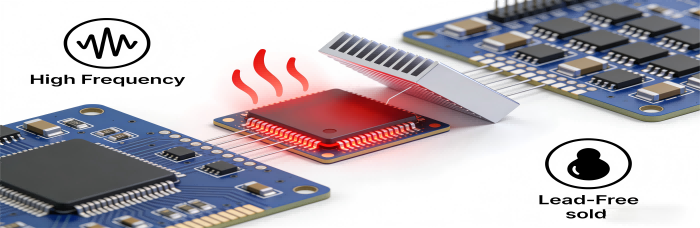
High-Frequency Applications: RF and microwave circuits inherently generate more heat because of the nature of operation. These applications demand specialized solutions to manage their thermal impact.
Lead-free soldering: Although environmentally friendly, the usage of lead-free solder requires higher temperatures for reflow, thus introducing additional thermal stress into the manufacturing process. Heat management strategies must now be revisited to accommodate this.
Strategies for Effective Temperature Management
Confronted with these difficulties, various ways have been developed by engineers to monitor PCB temperatures effectively:
Heat Sinks and Cooling Solutions: Incorporating heat sinks is one of the most straightforward methods to enhance heat dissipation. Cooling fans further aid air circulation, lowering overall temperatures and preventing hotspots.
Material Selection: Materials play a major factor in the thermal performance of a PCB. The high-performance materials such as heavy copper PCBs and those with high glass transition temperatures can support higher temperatures, hence offering great thermal regulation.
Optimizing PCB Design: Proper planning of component placement and spacing can do much to promote heat dissipation. Keeping the components that would generate heat away from the areas in the system that are sensitive to heat would be a proper way to maintain a balance.
Layer Stacking and Thermal Vias: Proper layer stacking with strategically placed thermal vias allows for effective heat dissipation. This reduces the formation of hotspots and maintains even temperatures.
Advanced Cooling Technologies: In high-power applications, liquid cooling or thermoelectric coolers may be applied. These methods provide advanced thermal management for extreme loads.
High-Temperature Laminates: Application of high-temperature laminates protects the PCB from extreme heat by preserving its structural integrity and functionality. Laminates pose a very important obstruction against thermal degradation.
Emphasizing the Role of CTE Alignment
The CTE is a measure of how much a material expands due to heat. Variations in CTE within the layers of a PCB will cause mechanical stress and even destroy the PCB. Alignment of the CTE in the dielectric and conductive layers allows engineers to ensure equal expansion without warping, particularly in multilayer boards. Such an alignment is important to the structural integrity of the board to avoid long-term damage.
Advanced Measurements of Temperature in PCBs
Since good temperature measurement is the basis of effective heat management, it requires careful choice and placement of temperature sensors by engineers. Some considerations are:
Identifying heat sources: Pinpointing primary heat-generating components, such as processors for targeted monitoring, thus enabling precise temperature control.
Strategic Sensor Placement: Place the sensors near the heat source and connect them to a ground plane. This minimizes thermal resistance, thus allowing for accurate readings to provide data in real time for making rapid adjustments.
Implementation of Diagnostic Tools: Modern thermal simulation and diagnostic so tware used in the design phase can provide a way to predict heat issues before even prototyping a design. This allows the identification and resolution of thermal challenges well in advance during the design phase.

Temperature control in PCBs is highly critical to the integrity, performance, and life of electronic devices. If excess heat develops, it can compromise structure, disrupt circuits, and escalate component failure risks. Therefore, thermal management becomes an essential consideration within PCB design. Knowledge of common causes of heat build-up-component malfunction, inefficient dissipation, and high-frequency usage-allows the engineer to take strategic interventions of material selection, component placement, and actual cooling methods. These efforts ensure collectively that PCBs operate efficiently and reliably under extreme conditions.
For those projects that need superior thermal management, PCBCart is one of the most trusted partners in the PCB industry. We offer a comprehensive array of solutions for high temperatures, including laminates and heavy copper material. Your custom PCB needs are designed to address specific customer needs, ensuring strength and efficiency in performance. Choose PCBCart to enjoy state-of-the-art technology and quality engineering support, making it the perfect partner for taking your electronic innovations to market. If interested in the services or products provided at PCBCart, please contact us for a quote today and commence improving your product's thermal performance.
Get an Instant Quote for High-Quality PCB Assembly
Helpful Resources
• PCB Thermal Design Considerations
• The Most Comprehensive Principles of Thermal Design for PCBs
• Metal Core PCB an Ideal Solution to Thermal Issues
• High-Power PCB in High Temperature Environment
• LED PCB Design and Quality Control
• Internal Thermal Dissipation Design of PCB based on Thermal Model


