



On a double-sided board, one side is assembled first and the other second, and the first side goes through heat again while it hangs upside down. The decisions that matter most are made in the layout: which parts sit on which side, how heavy they are, and where the board can be supported. Settling those points before you send files avoids most of the problems this process can cause.
What Happens to a Double-Sided Board
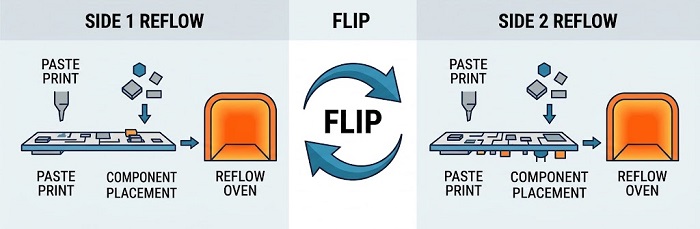
A double-sided board is built one side at a time. We assemble boards with components on one or both sides. Solder paste is printed on the first side, components are placed, and the board goes through reflow. Then the board is flipped, and the same sequence is repeated on the second side.
The key point is what happens to the first side during that second pass. Its solder joints are heated again, and the board is now upside down, so those components are held in place mainly by the solder and its surface tension. Most small parts stay put without trouble. Heavier parts deserve a closer look, and that is where layout decisions start to matter.
Choosing Which Parts Go on Which Side
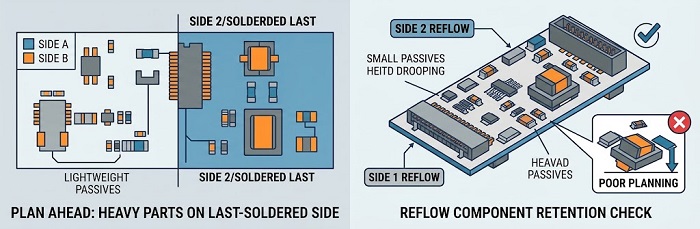
Weight is the first consideration. Parts on the side that is soldered last stay face-up during their own reflow, while parts on the first side hang upside down during the second one. There is no universal weight limit that clears every part, because the answer depends on the size of the pads and the shape of the component. As a general principle, heavier parts are better placed on the side that is soldered last, and any heavy part that has to go on the first side is worth reviewing before the build.
Tall parts, large connectors, transformers, and big BGAs all fall into that group. Heat sensitivity is the second consideration. Every part on the first side sees a second thermal cycle, so check each datasheet for limits on the number of reflow passes, and flag any part with a restriction. Some plastic-bodied parts may be better left to a later step.
Consider a controller board with a large connector, a transformer, and a few hundred small passives. The passives are light and can go on either side. The connector and transformer are not. Putting them on the side that is soldered last keeps them face-up during their own reflow and removes the question of whether they will hold during the second pass. That one decision, made early, is often the difference between a board that builds cleanly and one that needs special handling.
Product constraints often decide the rest. A connector has to line up with an enclosure cut-out, a power device may need to touch a heat spreader, and a sensor may need a clear opening. Start with those fixed points, then place the remaining parts so that the weight and heat concerns are balanced across both sides.
Support and Handling on the Second Pass
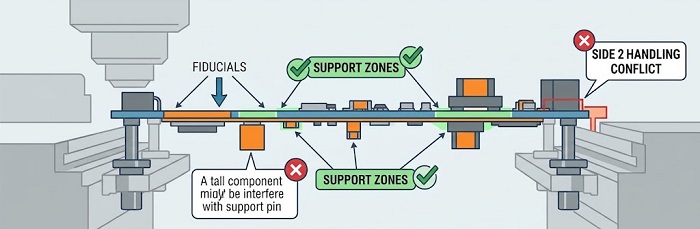
When the second side is printed and placed, the first side is underneath, with its components pointing down. The board has to be supported, and the supports need clear areas to rest on. If the first side is crowded all the way to the edges, there may be nowhere to put them. Leave support areas free, and keep tall parts away from the zones where the board is handled.
Panel design plays a part as well. Tooling strips, fiducial marks, and the spacing between units all affect how a board is carried and aligned, and our panel requirements describe what we need for assembly panels. If you only have a single board file, we can help panelize it.
Balancing Heat Across Both Sides
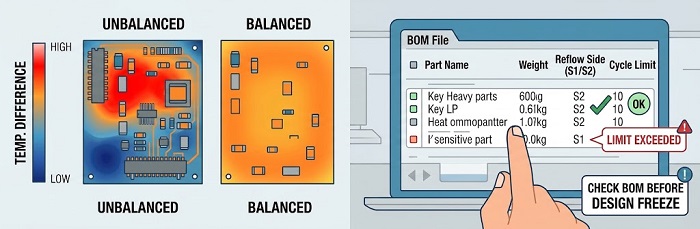
Heat behaves differently when both sides carry parts. Copper area, part density, and the mix of small and large components on each side all influence how evenly the board heats. A board with heavy parts crowded onto one side and light ones on the other heats unevenly, and that is harder to profile than a balanced layout. Spreading heavy parts across the board, and balancing copper where you can, keeps the temperature differences smaller.
Through-hole parts add one more consideration. If a double-sided board also carries through-hole parts, the through-hole step comes after both reflow passes and works from one side. Plan the placement of surface-mount parts on that side with the later step in mind.
What to Tell Us
Mark the side of every part in your BOM and placement file, and flag any part that is heavy, tall, or limited in reflow cycles. Say which side has to stay flat, for example against an enclosure or a heat sink. A free Valor DFM/DFA check is part of our assembly service, and it is a good moment to review all of this before the first build.
A few mistakes come up repeatedly. Putting the heaviest parts on the first side is the most common one, because those parts hang upside down on the second pass. Ignoring reflow-cycle limits is another, since every first-side part is heated twice. Crowding the first side out to the board edge leaves nowhere to support the board while the second side is printed. Concentrating heavy parts on one side makes the board harder to heat evenly.
FAQs
1. Do you assemble boards with parts on both sides?
Yes. We list single- and double-sided placement among our assembly capabilities.
2. Will every first-side part survive the second reflow?
Most small parts do, but each datasheet states its own limits. Flag any part with a limit on reflow cycles.
3. Can I put a large connector on the first side?
Sometimes, but heavy parts need review. Tell us which ones when you request a quote.
4. Does a double-sided board cost more than a single-sided one?
It adds a printing, placement, and reflow pass. Tell us how many sides carry parts in your quote request.
5. Which side should hold the tall parts?
Tall parts can interfere with support and handling on the second pass, so flag them for review.
The easiest double-sided board to build is one where the side for each part was chosen deliberately, with weight, heat, and support in mind, before the layout was frozen.
Get an Instant Quote for PCB Assembly
Helpful Resources
· A Full Understanding of SMT Assembly Procedure Helping YOU Reduce Production Cost


