



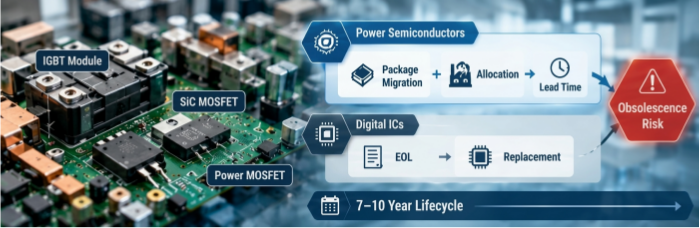
Power semiconductors do not age out of a bill of materials the way a general-purpose microcontroller or FPGA does. IGBT modules, SiC MOSFETs, and power MOSFETs sit at the intersection of two pressures that most digital ICs never face at the same intensity: wafer and packaging capacity is concentrated among a small number of fabs, and the package platforms themselves change generation faster than the multi-year design cycles of the industrial equipment they go into. For a program running on a 7–10 year lifecycle, that mismatch is where obsolescence risk actually lives.
Why Power Semiconductors Don't Follow the Standard Obsolescence Playbook
A general-purpose MCU or FPGA obsolescence event is usually a single-part problem: one device reaches end-of-life, and the response is to requalify firmware and footprint against a pin-compatible replacement. Power semiconductors introduce two additional variables:
Package platform churn. IGBT modules and discrete power devices move through package generations (e.g., successive TO-247, D2PAK, and module footprint revisions) on a faster cadence than the equipment programs consuming them. A device that is "in production" can still be migrating to a new package platform that is not pin- or thermal-pad-compatible with the prior revision.
Allocation-driven lead time swings, not just discrete EOL events. Rather than a clean last-time-buy notice, power semiconductor supply constraints frequently show up as lead-time extension and allocation, which functions like a soft obsolescence event even without a formal discontinuation. Trade press coverage in 2025 described high-voltage IGBT module lead times extending into the 8–16 week range with corresponding price increases, and separate 2026 reporting has flagged SiC MOSFET lead times extending past 52 weeks during tight allocation periods.
For an HMLV (High-Mix, Low-Volume) program, this means obsolescence planning for power devices has to track two signals in parallel — formal EOL/PCN notices and lead-time/allocation trend data — rather than relying on EOL notices alone.
Four Obsolescence Response Strategies, and Where the Power Device Category Diverges
The standard four-strategy framework used across semiconductor obsolescence management (last-time buy, form-fit-function alternate qualification, redesign/second-source enablement, and authorized-distribution inventory partnership) still applies to power semiconductors, but each strategy carries different weight than it does for an MCU or FPGA:
Last-time buy (LTB). For an MCU, an LTB is primarily a quantity and storage-life calculation. For a power module, storage life is a real constraint — die-attach and bond-wire interfaces are more sensitive to prolonged storage humidity and thermal cycling exposure than a digital IC in the same warehouse. LTB quantities should be sized against realistic shelf-life assumptions, not just projected consumption.
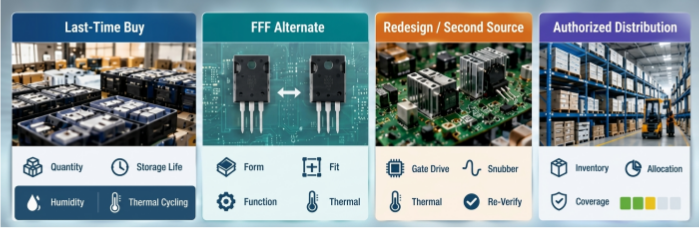
Form-fit-function (FFF) alternate qualification. This is where power devices diverge most from digital parts — covered in the next section, since electrical parameter matching alone is insufficient.
Redesign / second-source enablement. For an MCU, second-sourcing often means a pin-compatible part from a different vendor with similar toolchain support. For a power stage, second-sourcing typically requires re-verifying the gate drive network, snubber values, and thermal interface design around the new device — rarely a board-level drop-in even when form-fit compatible at the component level.
Authorized-distribution inventory partnership. Holding safety stock through an authorized distributor rather than a direct last-time buy tends to have shorter effective coverage windows for power semiconductors during allocation periods, since distributor buffer stock for high-demand power devices is drawn down faster industry-wide than for general-purpose logic parts.
Alternate Component Validation: Beyond Electrical Parameter Equivalence
Datasheet-level electrical equivalence (voltage rating, current rating, Rds(on) or Vce(sat) at a single test condition) is a necessary but insufficient basis for qualifying an alternate power semiconductor. Two additional validation dimensions matter specifically for this category:
Thermal characteristic matching. On-resistance and junction-to-case thermal resistance (Rth(j-c)) both need to be compared across the full operating range, not just at the datasheet's nominal test point. A candidate device with a similar Rds(on) at 25°C can diverge significantly at elevated junction temperature, which changes the thermal design margin of the assembly even when the device is otherwise form-fit compatible.
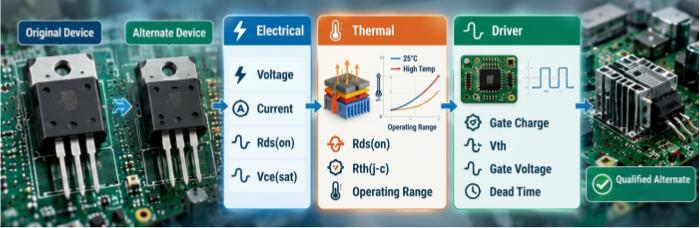
Driver circuit compatibility. Gate charge, threshold voltage, and — for SiC in particular — different recommended gate drive voltage windows compared with silicon IGBTs mean that a "compatible" alternate device can still require gate driver IC changes or dead-time adjustments. Validating a power semiconductor alternate without re-checking the driver interface is a common source of field failures that electrical-parameter-only qualification misses.
These are engineering validation steps that sit upstream of assembly; PCBCart's role in this workflow is process-level: closed-loop 3D SPI/AOI inspection and Smart MES lot traceability support consistent build execution once a validated alternate device is released to production, and off-line X-ray inspection (including oblique-angle capability) supports voiding assessment on BGA/QFN and power module solder joints during first article builds of a requalified device.
BOM Health Monitoring at the EMS Level for Power Device Categories
BOM health monitoring for power semiconductors follows the same general methodology used across a program's full component set — cross-referencing PCN/EOL notices, tracking distributor lead-time and allocation signals, and flagging single-source risk at the line-item level — but the power device category benefits from being reviewed on a shorter cycle than passive components or general logic parts, given how quickly lead-time and allocation conditions for this category can shift.
In practice, this means flagging power semiconductor line items for allocation/lead-time review more frequently than the rest of the BOM rather than on a single annual cadence; cross-checking any proposed alternate against the thermal and driver-compatibility dimensions above before it's accepted into an approved vendor list, not just against electrical datasheet parameters; and escalating package-platform migration notices — not only EOL notices — since a package change on an in-production power device can affect footprint and thermal pad design without a formal discontinuation.
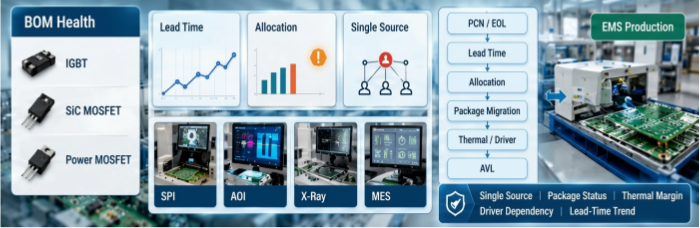
This is a methodology description of how BOM review is structured for this component category, not a commitment to a specific monitoring cadence or SLA — review frequency for a given program depends on its component list and should be scoped during quoting.
A Self-Check Framework for Power Semiconductor Obsolescence Risk
Before a program locks a power semiconductor into its BOM, it's worth running through a short internal check:
Single-source exposure. Is this device available from more than one qualified source today, or is there a documented FFF-qualified alternate on file?
Package platform status. Has the package platform for this device had a generation change in the last 24 months, and if so, is the current package the vendor's long-term platform or a transitional one?
Thermal margin at the alternate. If an alternate were needed tomorrow, is there a pre-identified candidate with Rds(on)/Vce(sat) and Rth(j-c) characterized across the operating range, not just at 25°C?
Driver interface dependency. Does the current gate driver design assume characteristics specific to this device family (e.g., a silicon-IGBT gate drive voltage window) that would need to change if the device were replaced with a SiC alternate?
Lead-time trend, not just EOL status. Has this device's lead time trended upward over the last two to three quarters, independent of any formal EOL notice?
Programs that answer "no" or "unknown" to more than one of these questions are carrying obsolescence exposure that a standard MCU/FPGA-style EOL tracker won't catch, because that exposure shows up as allocation and package migration rather than a clean discontinuation notice.
If your program has a power semiconductor BOM you'd like reviewed against this framework, submit the BOM for a risk screening and our team can flag single-source and package-migration exposure as part of early DFM review.


