



Nothing on the buyer's side shortens a distributor's quoted lead time. What you can control is when the clock starts, how many of your parts sit on it, and how much of the build has to wait for it. In practice that means buying earlier, approving alternates before you need them, holding stock deliberately, and shipping in parts when the program allows it.
Which of these makes sense depends on which part is late, how many units you build over the next year, and whether the BOM can still change. This article walks through each option and where it tends to go wrong. We don't promise delivery dates here, because component lead times are set by suppliers and move around.
How do you spot long-lead risk early?
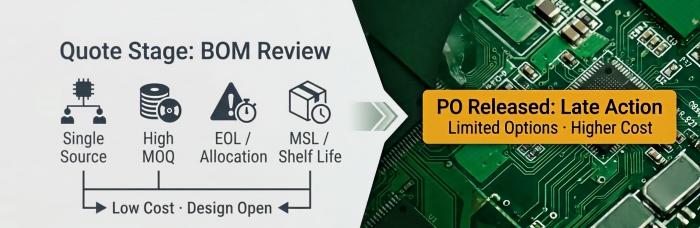
You spot it at BOM review during quoting, not when the purchase order is released. By the time a PO is out, the choices left are expensive ones.
We usually ask for the BOM at quote stage so that risk gets flagged while the design is still open. When we go through a BOM for HMLV work, these are the things we look for:
A single manufacturer part number with no approved alternate
A quoted supplier lead time longer than the time you have before the build is due
A minimum order or package quantity far above what one build consumes
Any end-of-life, last-time-buy or allocation notice from the manufacturer
A part with a long lead time that also needs special handling, such as moisture-sensitive packages or short shelf life
Custom or semi-custom items (magnetics, specialty connectors, programmed devices) where the supplier builds to order
The usual suspects are large FPGAs and memory, power modules, specialty connectors and custom magnetics. A BOM can still hide a problem in a ten-cent part, though. A single crystal or a particular connector housing with one source can stall a board that is otherwise ready. A cheap part can hold up the whole build.
The MOQ item matters more in HMLV than in volume production. If you need 40 pieces of a part and the supplier sells reels of thousands, the lead time may be fine but the cost and the leftover stock become the problem. Flag those separately from true lead-time parts, because the fix is different. Our component sourcing work covers how parts get sourced for builds like this, and that is the conversation to start before you commit to a schedule.
One more habit: re-check quoted lead times right before PO release. A figure you saw at the prototype stage can be out of date by the time the production build is approved. Treat any lead time on your spreadsheet as a snapshot with a date on it.
Buy early: who holds the stock and the cash?
Buying early is the simplest strategy, and the real question is who owns the parts while they wait. There are three common arrangements, and each puts the cash and the risk in a different place.
You buy and supply the parts. You place the orders, hold the inventory and send it to the assembler when the build is scheduled. You keep full control of the part source and the price. You also carry the carrying cost, the storage conditions and the responsibility for date codes and packaging condition. Before sending parts, confirm with our engineering team how received parts are checked, stored and labelled, because the answer affects whether the stock is usable when the build starts.
The assembler buys against your forecast. This lets you lean on the assembler's purchasing relationships. It only works if the agreement is written down: what quantity, over what period, and what happens to the unused balance if the forecast drops. Forecasts for HMLV programs shift all the time. A verbal "we'll probably build another batch in spring" is the typical source of a dispute over leftover parts.
Blanket orders or schedule agreements with a distributor. Some suppliers will commit to a quantity released over time. This can lock in availability for a part you know you will keep using, but it commits you to buying the whole quantity. This is rarely worth it unless the design is frozen and the part is genuinely single-source.
Whichever you choose, buffer stock for electronics has a shelf life that people underestimate. Moisture-sensitive devices have floor-life and storage limits. Date codes age, and solderability can degrade with long storage. A reel that sat in a cabinet for two years may need checking before it goes on a line. Hold buffer stock for the few parts that are long-lead and stable in your design, and not for the whole BOM.
Last-time buys are a special case of buying early. When a manufacturer announces a part is being discontinued, you can buy a lifetime quantity in one go. That locks the part but ties up money and storage for years, and you have to estimate demand well. Our article on how to manage obsolescence in medical device PCBA goes through that decision for long-life products, including when a redesign is the cheaper route.
Alternates and design flexibility
Approving alternates before you need them is the cheapest long-lead strategy, and it is the one most teams leave too late. An alternate approved during design review costs an engineer's afternoon. An alternate hunted for in the middle of a shortage costs a schedule slip and usually a rushed decision.
The ground rules we work to:
Alternates need your written approval. We don't swap a part without sign-off, and you shouldn't want us to. Even a part that looks identical on paper can differ in tolerance, temperature range or footprint tolerance.
Passives are easy, actives are not. A resistor or ceramic capacitor with the same value, package and rating is routine to approve. A voltage regulator, a microcontroller or a memory device may have different startup behavior, different firmware requirements or different timing. Those need engineering review.
Regulated products add re-qualification. If your product is in life sciences or other controlled applications, a change of part may mean documentation updates or repeat testing on your side. Factor that cost in before you call an alternate "free."
Design decisions stay with your team, since we start from your Gerber files and BOM and don't do schematic design. Still, there are a few things we see work at the layout stage:
Footprints that accept two package variants of the same function
Pin-compatible parts from more than one manufacturer where the function allows it
Standard component values in place of unusual ones
Test points and programming access that survive a change of programmed part
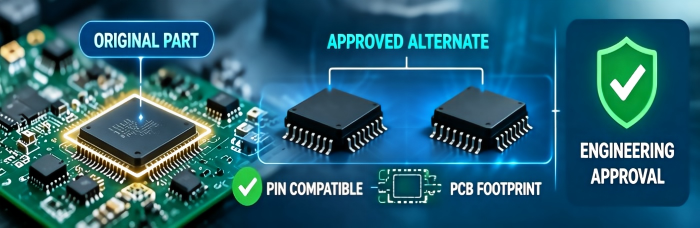
None of this is exotic. It is a few extra minutes at the schematic and layout stage, and it can turn a six-month wait into a part swap. If a part has only one source and a long lead time, ask whether the function can be met some other way before the design is released. After release, every one of those options gets more expensive.
Split deliveries and partial builds
If you can't get every part at once, you may be able to build what you can and finish the rest later. This works in some programs and fails badly in others, so decide per board.
There are two different versions of this idea.
Split lots. The full BOM is built in two or more runs. The first lot goes out with the quantity for which all parts were available, and the second lot follows when the missing part arrives. This is clean from a quality point of view, because each lot is a complete build. The cost is an extra setup and extra paperwork for HMLV work, since each run carries its own changeover and testing. Expect the per-board cost to be higher than a single combined run.
Partial builds with a part added later. The board is assembled without one component, and that component is added in a second pass. This is only sensible for parts that can be added without disturbing what's already on the board. Through-hole connectors and some larger discrete parts are the usual candidates. A fine-pitch device or a BGA is a different story, since adding it later means another thermal exposure for the whole assembly or a rework step. Whether a specific part can be added in a second pass is something to confirm with our engineering team before you plan around it. Don't assume.
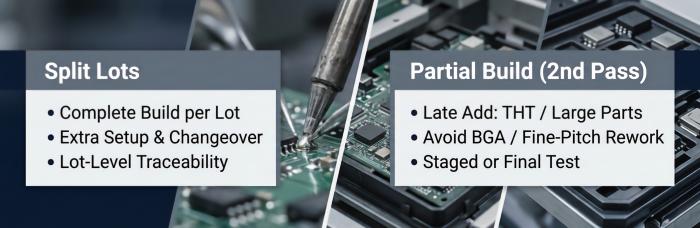
Two things to settle before you split anything. First, how will the incomplete boards be stored and identified so they don't get shipped by mistake? Second, how will testing work? A board missing a part may not be testable end to end, so decide whether functional test happens after the final pass or in stages.
Fabricating the bare boards early is a related option. It keeps the PCB from becoming a second long-lead item while you wait for components. It only makes sense when the layout is stable, since a revision after the boards are made means scrap.
If your program is low-volume and high-mix, the trade-offs between split runs and one consolidated build also depend on how setup is handled, which varies by job.
Which strategy fits which situation?
| Situation | Strategy worth considering | Who carries the cost or risk | What to watch |
|---|---|---|---|
| One part is long-lead, design is frozen, product will be built for years | Early buy or blanket order for that part | You, as cash and storage | Shelf life, date codes, forecast accuracy |
| Manufacturer has issued an end-of-life notice | Last-time buy, or redesign around a replacement | You | Lifetime demand estimate; the cost of re-qualification if you redesign |
| Part is long-lead but the design is still open | Approve alternates or add a second footprint | Your engineering time | Written approval; re-testing for regulated products |
| MOQ far above what the build needs | Buy the full reel, or ask whether a cut quantity is available through sourcing | You, in leftover stock | Whether the leftover will ever be used |
| Most parts are in hand, one is late | Split lot, or partial build with a later pass | Both sides, as setup and handling cost | Whether the late part can be added without rework |
| Boards are ready but one component is delayed and the delay length is unknown | Hold the build; don't start a partial run | You, as schedule | Re-check the lead time before deciding to wait |
| Single-source part, no alternate, no design change possible | Early buy plus close monitoring | You | This is the highest-risk case. Don't rely on a single plan |
Most real programs end up using two or three of these together. A common combination is an approved alternate for the passives, an early buy for the one active part with no substitute, and a split lot if the schedule can't wait.
FAQ
How do I know if a quoted lead time is realistic?
Ask for the date the quote was given and whether it is a factory lead time or a distributor's current stock position. A distributor showing zero stock with a long lead time is giving you the factory number, which can change. When a lead time looks suspiciously short for a part you know is scarce, ask where the stock is held and in what quantity.
Should we do a last-time buy or redesign?
It comes down to how long you will keep building the product and what a redesign would cost in engineering and re-qualification. A last-time buy suits a product with a defined end of life. A redesign suits a product that will stay in production well past what any stock could cover. Neither is free, so price both before you choose.
Can the assembler hold stock for us?
That depends on the arrangement, and it should be agreed in writing, including who owns the parts and what happens to any balance. Confirm the specifics with our engineering team before you plan around it.
Does a split lot affect traceability?
Each lot should carry its own build records so the two runs aren't mixed up. Ask for lot-level records when you set up the program, since adding them afterwards is harder.
What do we do when the only alternate has a different footprint?
Treat it as a design change and not as a purchasing change. That means a layout revision, a new Gerber release and possibly a new stencil. Sometimes it is still the quickest path, but it should be a deliberate decision with your engineering team.
Helpful Resources
• What Happens to My Lead Time When a Component Goes Out of Stock?
• Does the Quoted Lead Time Include Procurement and Shipping, or Just Production?
• What's the Difference Between Consignment and Turnkey Assembly, and Which Is Cheaper?
• Effective Ways of Moisture Sensitive Device Storage and Handling
• How to Create a BOM (Bill of Materials)


