



Choosing between conformal coating and potting is not a question of which is "stronger." It is a decision about the dominant failure mode, the need for future serviceability, and the thermal-mechanical stress the protection itself introduces. This framework compares both approaches for PCBA used in harsh industrial, medical, and semiconductor test environments, and ends with a decision matrix you can apply to your own program.
The Core Difference: Thin and Serviceable vs. Monolithic and Permanent
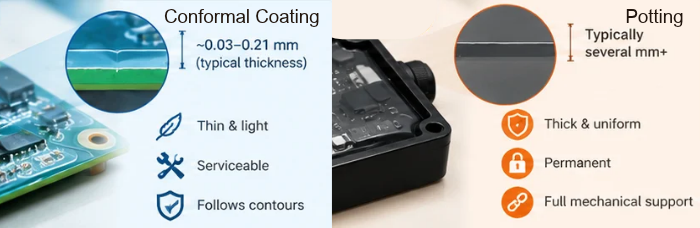
Conformal coating is a thin dielectric film applied over the assembled board. IPC-A-610 and J-STD-001 list typical cured thickness in the range of roughly 0.03–0.13 mm for acrylic, epoxy, and urethane types, and about 0.05–0.21 mm for silicone. The film follows component contours, adds negligible mass, and can usually be removed locally (solvent, thermal, or mechanical methods, depending on chemistry) so the board can be reworked.
Potting, also called encapsulation, fills a housing or mold with resin so the board is embedded as a solid block. The protection is thick, uniform, and mechanically coupled to every component. The trade-off is that the assembly becomes effectively non-maintainable: removing the compound without damaging the board is impractical for most epoxy systems and difficult even for soft silicones.
Which Failure Modes Each Process Addresses
Moisture and condensation: A well-applied coating controls surface leakage and dendritic growth on fine-pitch features under humidity cycling. Potting is the stronger choice when the board may see splashing, immersion, or pressure-driven liquid ingress, because the barrier is continuous and thick.
Vibration and shock: Coating adds almost no mechanical support. Potting supports heavy parts such as transformers, tall inductors, and electrolytic capacitors, and reduces resonance-driven solder joint fatigue. The compound can also create stress of its own, which is why material selection matters.
Chemical and corrosive exposure: Coating chemistries differ widely in solvent and chemical resistance, so the exposure profile must be matched to the film type (IPC-HDBK-830 provides the selection guidance). Potting offers a thick barrier, but the compound itself must be chemically compatible with the environment.
Potting Material Selection: Epoxy vs. Silicone
The selection logic turns on two questions: must the unit ever be repaired, and how severe is the temperature cycling?
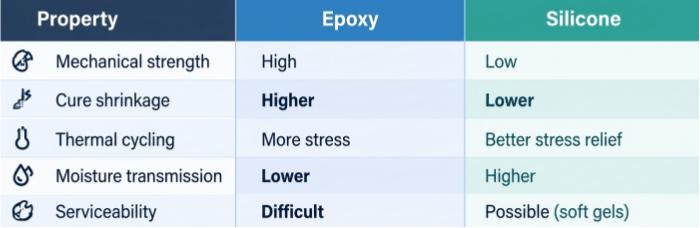
Epoxy potting compounds are hard, strongly adhesive, and mechanically robust, with good chemical resistance and low moisture vapor transmission. The drawbacks are higher cure shrinkage and a coefficient of thermal expansion (CTE) that is far from that of solder, ceramic, and silicon. Across wide thermal cycles, that mismatch can load solder joints, ceramic capacitors, and bond wires. Epoxy is the right fit when mechanical retention and chemical barrier matter most and the assembly will never be opened.
Silicone potting compounds (gels and soft elastomers) have low modulus, a broad service temperature range, and excellent stress relief during thermal cycling. Soft gels can often be cut through or probed for diagnosis, which preserves a limited repair path. The trade-offs are lower mechanical strength, generally higher moisture vapor transmission than epoxy, and a frequent need for primers to achieve reliable adhesion.
In practice: choose epoxy for rigid, high-shock, sealed-for-life units; choose silicone where thermal cycling dominates or limited serviceability is valuable. Polyurethane sits between the two and is worth evaluating when neither extreme fits. Always confirm the final choice against the compound manufacturer's datasheet and your own qualification testing.
Potting Process Execution: Where Programs Fail
A good material applied badly produces latent defects that surface only in the field. Three controls matter most.
Vacuum Degassing
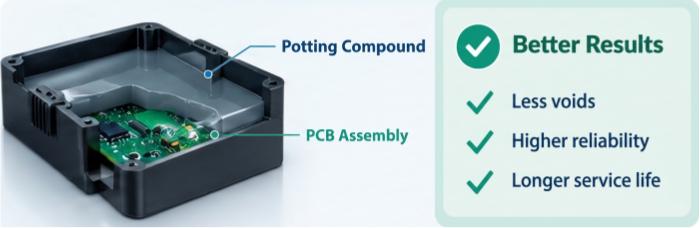
Mixing introduces air, and viscous compounds trap it around dense component clusters. Voids under or beside components create high-field points in high-voltage designs and weak spots for moisture. Degas the mixed material under vacuum before dispensing, and where geometry demands it, pour or dispense under vacuum so air is not re-trapped on the board. Pour in a controlled flow from one location so the resin front pushes air out rather than closing around it.
Mold and Housing Design
The housing is part of the process, not just packaging. Design for a defined fill path, vent points at the highest locations, and adequate flow clearance under tall components. Specify keep-out regions and masking for connectors, test points, and anything that must remain accessible. Check that housing material, mold release, and compound are mutually compatible, since contamination at the interface is a common adhesion failure.
Cure Temperature Profile
Cure schedule controls residual stress. A rapid, hot cure on a thick section can create exotherm gradients and shrinkage stress that load joints before the product ever ships. Use the manufacturer's recommended cure schedule, favor staged or ramped cures for large fill volumes, and let the part cool gradually. Any profile change should be treated as a process change and re-validated.
Board Readiness Before Potting
Because potting removes the rework option, the board must be proven good first. Trapped flux residue can drive corrosion beneath the compound, so cleanliness verification before potting is essential. Inspection also needs to be complete: 3D AOI for placement and solder joint geometry, off-line X-ray for BGA and QFN voiding, and functional verification before encapsulation. Lot and process records tied to a unique ID, such as a Smart MES with UID traceability, keep the pre-potting history attached to each unit. These are manufacturing-record capabilities that support the protection process, not substitutes for qualification testing by the OEM.
Industry Selection Tendencies
These are typical tendencies, not rules. Always validate against your own environmental and regulatory requirements.
Industrial outdoor and stationary equipment tends toward potting. Power conversion, grid-scale energy storage controllers, and remote industrial IoT nodes face temperature extremes, condensation, dust, and vibration, often with long field life and infrequent access. Potting gives mechanical retention and a sealed barrier. Where thermal cycling is severe, silicone-based systems are commonly favored over rigid epoxy.
Medical diagnostic equipment tends toward conformal coating. Instruments are frequently serviced, calibrated, and repaired, so preserving maintainability usually outweighs the added barrier of potting. Coating also keeps weight low and leaves the board accessible for rework and failure analysis. Where cleaning chemistry or humidity is a concern, coating selection should reflect the specific disinfectants and fluids involved.
Semiconductor test boards are generally not potted. Interface and load boards must remain testable, probeable, and often reworkable, and their sockets, connectors, and contact areas cannot be covered. When protection is needed, selective coating with masking over sensitive zones is the more compatible approach.
Selection Decision Guide
Use the following conditions as a starting point for selection.
Splash, immersion, or pressure-driven liquid exposure → potting. A continuous, thick barrier is needed, and a thin film may not hold up under direct liquid exposure.
Humidity and condensation only, with a need for repair → conformal coating. Surface protection addresses leakage and corrosion while keeping the board serviceable.
Heavy components under high vibration or shock → potting (epoxy or polyurethane). Mechanical coupling supports large parts and reduces joint fatigue from resonance.
Wide thermal cycling with fragile components → silicone potting or conformal coating. Low-modulus materials limit the stress transferred to solder joints and ceramic parts.
Field-serviceable or frequently calibrated equipment → conformal coating. Local removal and rework remain possible after protection.
Boards with sockets, probe points, or test interfaces → selective coating or none. Accessibility and testability outweigh the added barrier.
Sealed-for-life unit with no service plan → potting. Maintainability has no value, so mechanical and barrier performance can dominate.
When two conditions point in different directions, rank the requirements: failure mode first, serviceability second, thermal-mechanical stress third. Then prototype and test the leading option under your real environmental profile.
The right choice depends on your board density, environment, and service model. To get a protection-process assessment alongside your assembly quote, submit your project through PCBCart's assembly RFQ page with your BOM, assembly drawings, and environmental requirements. Our engineers will review pre-protection inspection, cleanliness, and traceability needs for your build.
Helpful Resources
• PCB Protection: Potting or Conformal Coating?
• PCBA Conformal Coating for Industrial Automation Reliability
• Quality Documentation & Traceability Requirements for Semiconductor Test Equipment OEMs


