



High-mix, low-volume (HMLV) PCBA sourcing decisions are still routinely made on a single number: the per-unit assembly price on a quote sheet. That number is easy to compare across suppliers, which is exactly why procurement teams default to it — and exactly why it produces bad sourcing decisions.
Tier-1 EMS providers are structured around high-volume repeatability, which is precisely why their quoting logic is frequently a poor fit for HMLV programs. If a supplier's operating model doesn't match the workload, then the quote line item that model produces isn't a valid basis for comparison either. Unit price reflects how a supplier's cost structure allocates against a hypothetical smooth production run. HMLV programs rarely run smoothly. The real comparison has to happen at the level of total program cost, not unit price.
The Unit Price Illusion
Unit price is attractive to compare because it's a single scalar. But for HMLV work — small lots, frequent engineering changes, mixed product lines, sporadic release schedules — unit price is measured under conditions that don't resemble how the board actually gets built.
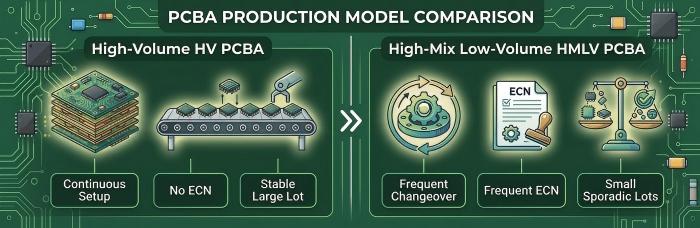
A quoted unit price typically assumes:
A defined lot size run in a single continuous setup
No engineering changes between quote and build
First-pass yield at or near the supplier's stated average
No schedule compression or expedite requests
HMLV production violates most of these assumptions by definition. Low volumes mean setup and changeover costs are spread across fewer units. Frequent revisions mean NRE gets re-incurred more often. Mixed product lines mean an assembler's line-balancing and changeover discipline matters more than raw piece-price efficiency. None of this shows up in the unit price line.
A Total Cost Framework for HMLV PCBA Sourcing
A defensible sourcing comparison treats unit price as one input among several, weighted by how a given supplier's operating model actually behaves under HMLV conditions.
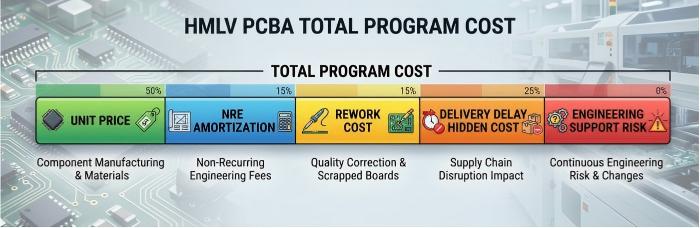
Unit Price
Still relevant — it's the baseline material and labor cost per board at the quoted lot size. The framework doesn't discard it; it stops treating it as sufficient on its own.
NRE Amortization
Non-recurring engineering costs — stencil fabrication, test/programming setup, fixture design, first article inspection — are fixed costs spread across the lot. At HMLV lot sizes, NRE per unit can represent a meaningful share of total program cost, and how a supplier bills it (itemized per build vs. amortized across an annual forecast) changes the real comparison materially. Two suppliers quoting the same unit price can produce very different total costs depending on NRE structure alone.
Rework Cost
Rework cost is a function of first-pass yield and defect escape rate, neither of which is visible in a unit price quote. When a board fails inspection or test, the cost isn't just labor to rework it — it's line time, retest, and often re-inspection under a supplier's traceability system. A supplier with a lower unit price but weaker inspection coverage (for example, no closed-loop SPI/AOI, or no X-ray coverage on BGA/QFN voiding) shifts yield risk downstream, where it surfaces as unplanned rework cost rather than a line item on the original quote.
Hidden Cost of Delivery Delay
Schedule slip on an HMLV board — often built for a specific test system deployment, clinical instrument release, or automation line commissioning — has a cost that rarely appears on a supplier scorecard: downstream schedule compression, expedite freight, or a customer's own delayed shipment to their customer. This cost is asymmetric. A one-week delay on a high-volume consumer board is usually absorbed by inventory buffer. A one-week delay on a low-volume, engineering-critical board frequently has no buffer to absorb it into.
Engineering Support Responsiveness
HMLV programs generate more engineering touchpoints per dollar of spend than high-volume programs do — DFM feedback, component substitution decisions during obsolescence events, test coverage discussions, deviation approvals. A supplier's responsiveness on these touchpoints is a real cost driver: slow DFM turnaround delays the whole program start; slow deviation approval stalls a build that's already on the line. This is difficult to quantify in a spreadsheet cell, but it belongs in the qualitative section of a sourcing evaluation, not left out of it.
How Low-Price Suppliers Shift Cost to the Customer
The mechanism is consistent across cases, even without referencing specific supplier data: a quoted unit price can be minimized by controlling only the variables visible at quoting time — material cost, standard labor rate, standard lot assumptions — while leaving the variables that surface after the quote (yield, schedule reliability, engineering bandwidth) unmanaged or unstated.
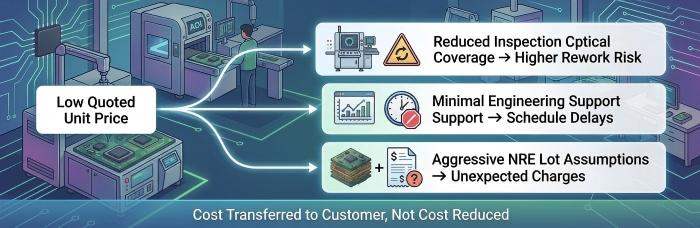
The result is a cost transfer, not a cost reduction:
Lower inspection coverage reduces quoted cost but increases the probability that yield loss is discovered at incoming inspection or in the field, where the cost of failure is higher than at any point during assembly.
Aggressive lot-size assumptions in NRE amortization make the quoted unit price look competitive at a volume the customer may not actually order, with true amortized cost re-emerging on real-volume purchase orders.
Minimal engineering support capacity keeps overhead — and quoted price — low, but pushes DFM and deviation-handling delays onto the customer's own schedule.
None of this requires bad faith on the supplier's side; it's often simply the predictable output of a cost structure not built for HMLV variability. The framework's purpose is to make that transfer visible during quote comparison, rather than discovering it mid-program.
Applying the Framework in Quote Evaluation
In practice, applying this framework changes the sourcing conversation from "which quote is cheapest" to "which supplier's cost structure matches how this program will actually run." For an HMLV program with frequent revisions, mixed lot sizes, and engineering-critical applications — such as semiconductor ATE interface boards, life sciences instrumentation, and industrial automation control boards — that second question is the one that determines actual program cost, not the first.
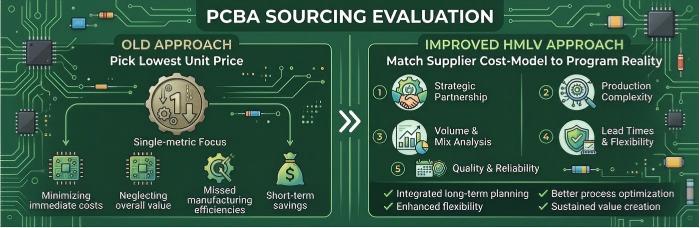
HMLV PCBA sourcing decisions require different evaluation criteria than high-volume sourcing — from equipment capability and inspection coverage to documentation practices and vendor evaluation frameworks. Unit price comparison is the final piece of that pattern: a metric imported from high-volume sourcing logic that doesn't hold up under HMLV conditions.
Teams preparing an HMLV PCBA sourcing decision can submit an RFQ with program details — lot size pattern, revision frequency, and inspection/test requirements — and request a total cost comparison framework structured around the categories outlined above, to support an apples-to-apples evaluation across quotes.
FAQs
Is unit price irrelevant to HMLV sourcing decisions? No — it remains one input in the total cost comparison. The issue is treating it as the only input, when NRE structure, yield-driven rework exposure, schedule reliability, and engineering support responsiveness all affect actual program cost independently of the quoted price.
How should a buyer estimate rework cost exposure before placing an order? Ask suppliers directly what inspection and test coverage is included at the quoted price — closed-loop SPI/AOI, X-ray coverage on BGA/QFN packages, and test strategy (ICT, flying probe, or functional test). Coverage gaps are a leading indicator of where yield risk, and therefore rework cost, is likely to surface later.
Does a lower NRE amortization lot size always favor the buyer? Not necessarily. A low amortization lot size can make a unit price look attractive on paper while creating a mismatch if actual order volumes turn out to be lower — the NRE gets under-recovered and may be re-quoted or re-billed on subsequent orders. Confirm the assumption against realistic order patterns before comparing quotes.
Why does engineering support responsiveness belong in a cost framework rather than a service-quality discussion? Because delays in DFM feedback or deviation approval have direct schedule and cost consequences for HMLV programs, which have less buffer to absorb them than high-volume programs. It behaves like a cost driver even though it isn't priced on the quote sheet.
Helpful Resources
• RFQ Checklist for HMLV PCBA Quotes
• True Cost Breakdown of HMLV PCBA Builds: NRE, Engineering Setup & Unit Economics
• 10 Questions to Ask Any EMS Partner Before Signing
• IPC-A-610 Class 3 Visual Inspection Guide for Industrial & Medical Assemblies
• X-Ray Oblique-Angle Inspection Protocols for Multi-Layer ATE Interface Board BGA


