



Surface finish selection is a first-pass yield decision as much as a materials decision. For high-mix, low-volume (HMLV) PCBA programs — where a single line may run industrial control boards one shift and semiconductor ATE interface boards the next — the wrong finish choice shows up downstream as solder voiding, black pad failures, or shelf-life scrap long before it shows up as a field return. This article compares Electroless Nickel Immersion Gold (ENIG), Immersion Silver, and Hot Air Solder Leveling (HASL) across solderability, planarity, storage behavior, and fine-pitch compatibility, and closes with a selection framework for assembly teams sourcing across industrial, life sciences, and semiconductor test equipment applications.
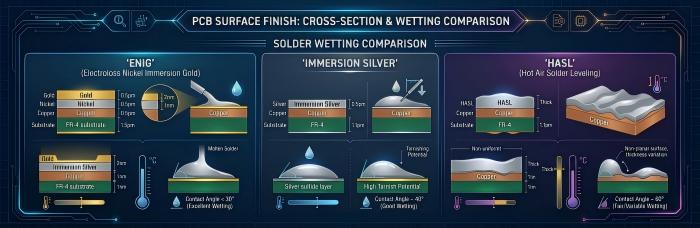
Solderability and Wetting Behavior
Each finish interacts differently with paste deposition and reflow, which matters directly for MYCRONIC jet-printed paste volumes and reflow profile control on a JTR-1200D-N oven.
ENIG deposits a nickel barrier layer under a thin immersion gold flash. The gold dissolves rapidly into the solder during reflow, and wetting is governed by the underlying nickel-solder interface. This generally produces consistent, flat wetting angles across a panel, which is favorable for automated optical and SPI-based paste inspection because the pre-reflow paste geometry maps predictably to post-reflow joint geometry.
Immersion Silver wets very readily — silver is solder-compatible without an intermetallic barrier layer, so wetting speed is typically fast and joint formation is direct. This is advantageous for fine-pitch, low-standoff components where minimizing intermetallic complexity reduces one variable in joint reliability. The tradeoff is that silver is more sensitive to sulfur-bearing atmospheric contaminants pre-reflow, which can produce localized dewetting if boards are stored or handled outside recommended conditions.
HASL (including lead-free HASL) leaves a tin-based solder layer directly on the pad, so wetting during reflow is essentially solder-to-solder. Bulk solderability is generally excellent and forgiving of process variation. The limitation is at the pad geometry level, addressed below.
Planarity and Fine-Pitch BGA/QFN Compatibility
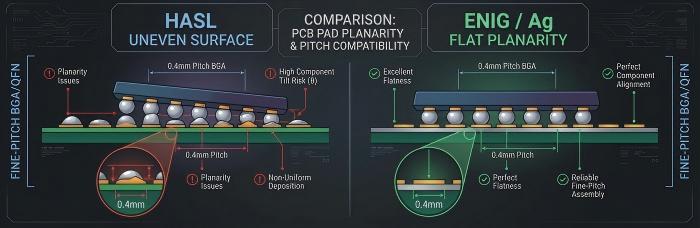
This is where the three finishes diverge most sharply for HMLV programs that routinely mix fine-pitch BGA and QFN packages with legacy through-hole content on the same panel.
HASL planarity risk: The HASL process leaves a naturally non-uniform solder layer, with coplanarity variance across a panel that becomes a real constraint below roughly 0.5 mm pitch. For 0.4 mm-pitch BGA and fine-pitch QFN, uneven pad topology increases the risk of insufficient or bridged joints that 3D SPI can flag pre-reflow but cannot fully correct — the underlying pad surface is the limiting factor, not the paste deposit. HASL is generally a poor fit for the finest-pitch packages common in semiconductor ATE interface boards.
ENIG black pad risk: ENIG's known failure mode is "black pad" — a hyper-corroded nickel surface caused by excessive galvanic displacement during the immersion gold deposition step at the board fabricator. Black pad is invisible on incoming inspection and typically only manifests as brittle, non-wetting or partially-wetted joints under mechanical stress — a genuine concern for BGA and QFN packages where joint integrity can't be visually confirmed post-reflow without X-ray. This is a strong argument for closed-loop 3D AOI and offline oblique-angle X-ray as standard inspection steps on ENIG-finished fine-pitch boards, since voiding and non-wet joints under BGA/QFN packages are otherwise undetectable by visual inspection alone.
Immersion Silver planarity: Because immersion silver is a thin, uniform deposit with no leveling step, it offers planarity closer to ENIG than to HASL, without the black pad failure mode. This makes it a common choice for fine-pitch, high-density boards where flat, consistent pad topology matters more than long shelf life.
Storage Conditions and Shelf Life
Surface finish selection is inseparable from inventory and handling practice on HMLV lines, where boards from different customers and different fabrication lots may sit in kit staging for varying lengths of time before assembly.
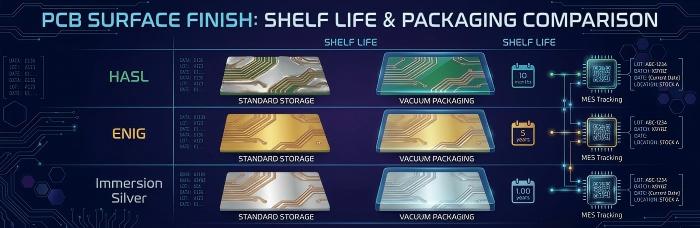
HASL has the longest practical shelf life among the three and is comparatively tolerant of ambient storage, which is one reason it remains common for cost-sensitive industrial control boards with simpler pitch requirements.
ENIG has good shelf life under standard ESD-safe, moisture-barrier storage conditions, since the gold flash protects the nickel from oxidation; the black pad risk is a fabrication-process variable rather than a storage-duration variable.
Immersion Silver has the shortest recommended shelf life of the three and is the most sensitive to storage atmosphere — sulfur exposure, humidity, and handling (fingerprints, ambient contaminants) can degrade solderability before reflow. Programs using immersion silver generally need tighter kitting discipline: vacuum-sealed or nitrogen-purged storage, first-in-first-out lot tracking, and shorter time-in-stock targets between receipt and assembly. Smart MES with UID-level lot traceability is particularly useful here, since it allows staging time to be tracked and flagged per lot rather than assumed.
Finish Selection by Industry Segment
These are general industry tendencies, not fixed rules — actual selection should be driven by the specific package mix, reliability requirements, and cost target of each board.
Industrial automation boards frequently mix HASL and ENIG depending on pitch. Boards dominated by connectors, discrete power components, and coarser-pitch ICs often use HASL for cost reasons. Boards carrying fine-pitch microcontrollers or FPGA packages more often specify ENIG or immersion silver.
Life sciences electronics — diagnostic and monitoring boards in particular — lean toward ENIG or immersion silver more consistently, driven by the combination of fine-pitch sensor interface ICs and the documentation expectations common in regulated medical device supply chains, where consistent, well-characterized joint formation supports process validation records.
Semiconductor test equipment (ATE) interface and probe boards tend to specify ENIG or immersion silver almost by default, given the prevalence of fine-pitch BGA and QFN packages and the high cost of field failure in a test cell. Where ENIG is specified on these boards, pairing it with oblique-angle X-ray inspection is a reasonable process control step given the black pad detection gap noted above.
Surface Finish Selection Matrix
| Priority | Recommended Finish | Rationale |
|---|---|---|
| Fine-pitch BGA/QFN, flat pad geometry required | Immersion Silver or ENIG | Uniform deposit thickness; avoid HASL's coplanarity variance |
| Longest shelf life / flexible kitting schedules | HASL | Most tolerant of ambient storage duration |
| Mixed fine-pitch and legacy through-hole on one panel | ENIG | Broad compatibility across package types; pair with X-ray inspection |
| Cost-sensitive, coarser-pitch industrial boards | HASL | Lowest finish cost, adequate for the pitch range |
| Tight kitting control with fine-pitch requirements | Immersion Silver | Best planarity-to-cost ratio when storage discipline is in place |
No single finish is universally correct across an HMLV program's board mix — the decision should be made per board family, weighing pitch, storage timeline, and inspection capability together rather than defaulting to one finish across an entire product line.
Get a Surface Finish Recommendation for Your Board
Selecting the right surface finish for a fine-pitch, multi-industry board mix is easier with process data specific to your package types and volumes — pitch, panel mix, storage timeline, and target reliability all factors differently depending on the finish. Submit your project details and our engineering team will review your BOM and board mix for an assembly-focused surface finish and process recommendation.
Helpful Resources
• The Most Comprehensive Guidelines for Surface Finish Selection
• What is the IPC Standard for ENIG?
• Mitigating Moisture Sensitivity Level (MSL) Risks in High-Density SMT Assembly
• IPC-A-610 Class 3 Visual Inspection Guide for Industrial & Medical Assemblies


